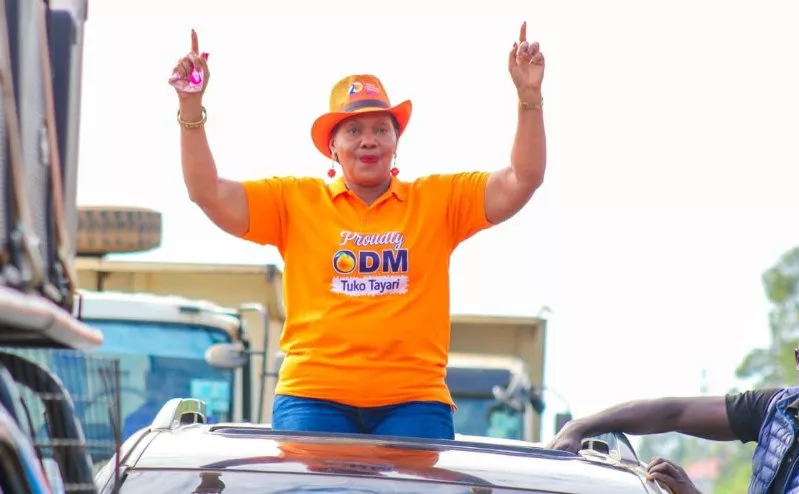
 Kisumu West MP Rozaah Buyu
Kisumu West MP Rozaah Buyu has declared her intention to run for the governor's seat in 2027, becoming the latest entrant to a race that is increasingly becoming crowded.
Deputy Governor Mathews Owili, Senator Tom Ojienda, Kisumu Central MP Joshua Oron, Nyakach MP Aduma Owuor, Woman Representative Ruth Odinga and former Kisumu Central MP Ken Obura are all in the race to succeed Governor Anyang Nyong'o.
Buyu announced her bid during a church service in Kisumu over the weekend, saying she had sought God's guidance before deciding to enter the race.
Buyu, who previously served as Woman Representative, said she is an experienced leader who is ready to steer the county to the next level.
"I have what it takes to be the third governor of Kisumu. My track record speaks for itself," she said.
While the list of aspirants continues to grow, political observers say the real contest is likely to revolve around four questions: who inherits the ODM political machine and whether voters will demand continuity or change after Nyong'o's two terms.
A candidate's development record will outweigh party loyalty and the final issue will be about alliances formed before party nominations.
Kisumu has remained one of ODM's strongest political bastions, with elections largely influenced by the party's popularity and the enduring influence of the Odinga family.
However, the emerging succession race suggests that traditional political calculations may be under increasing pressure.
Several aspirants are already attempting to distinguish themselves beyond party politics by focusing on governance, development and economic transformation.
Ruth Odinga has anchored her campaign on economic empowerment under the slogan of money in the pocket while promising greater support for small businesses, youth, women, persons living with disabilities and self-help groups.
She has also challenged voters to move away from electing leaders solely on the basis of party affiliation or campaign handouts, arguing that leadership should instead be judged by performance and delivery.
Her message reflects growing calls for issue-based politics, although it will also test whether Kisumu's long-standing voting patterns are beginning to shift.
Owili enters the contest carrying both an advantage and a burden.
Having served alongside Nyong'o throughout the current administration, he is well placed to campaign on continuity and institutional experience.
At the same time, he may have to defend the county government's record on service delivery and convince voters that continuity does not mean maintaining the status quo.
Buyu is positioning herself differently, banking on her legislative experience and development record while presenting herself as a fresh but experienced alternative.
Oron is expected to leverage his growing profile in Parliament, while Ojienda brings national visibility and legal expertise that could appeal to sections of the electorate seeking technocratic leadership.
Aduma is likely to rely on his grassroots networks, while Obura has chosen to challenge the dominance of party politics altogether.
Running as an independent candidate, Obura argues that party nominations often deny voters the opportunity to elect the most capable leaders and weaken accountability once leaders assume office.
His candidature could become an important test of whether independent politics can gain traction in a county where party loyalty has traditionally determined electoral outcomes.
Beyond the individual campaigns, the succession race is exposing a broader political transition in Kisumu.
For the first time in years, the county is preparing for leadership without an incumbent seeking re-election, creating space for multiple centres of influence to emerge.
The large number of aspirants also makes alliances, negotiations and possible withdrawals almost inevitable before party nominations and the ballot itself.
Gender politics is also expected to feature prominently.
With Buyu and Ruth Odinga among the leading contenders, women could play a central role in shaping the contest.
Yet the two are pursuing markedly different strategies — Buyu emphasising experience and legislative performance, while Ruth has centred her campaign on economic empowerment and grassroots livelihoods.
Ultimately, the battle to replace Nyong'o is becoming a referendum not only on his legacy but also on the direction Kisumu wants to take after 2027.
Whether voters choose continuity, demand change, or prioritise performance over political pedigree may determine not just the next governor, but the future trajectory of politics in one of ODM's most influential strongholds.
![[PHOTOS] Obado Leaves court in handcuffs](https://cdn.radioafrica.digital/image/2026/07/efc75d55-2eb9-4019-bb24-937dc4fc4f56.webp)