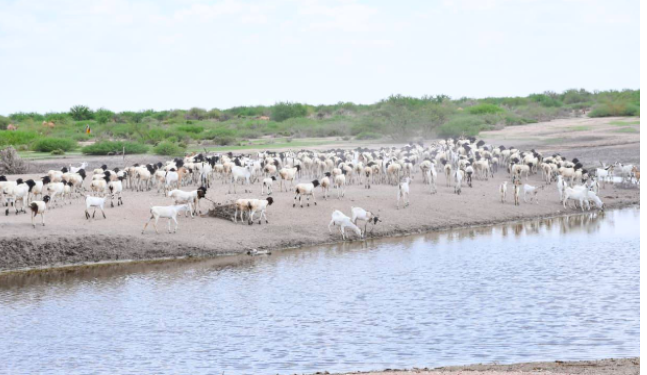
 Sheep and goats drinking water from one of the few remaining water pans in Mandera North. /STEPHEN ASTARIKO
The European Union
has given €250,000 (Sh37.5 million) in humanitarian aid to support affected
communities facing overlapping climate and health emergencies.
The fund is meant to cushion
communities affected by Kenya’s rapidly deteriorating humanitarian situation,
marked by prolonged drought, severe flooding and fast-spreading disease
outbreaks.
“More than 1.8 million people are currently facing acute food
insecurity, with projections rising to 2.1 million by January 2026. Water
sources are shrinking, malnutrition is increasing, and humanitarian funding
continues to decline,” the EU said.
“The EU’s emergency contribution
will enable the Kenya Red Cross Society to provide essential food assistance,
clean water, cash support, healthcare and protection services to the most
affected communities.”
The six-month project, running
until the end of May next year, is expected to support more than 150,000
vulnerable people affected by the converging crises.
The EU said the funding is
part of the overall contribution to the Disaster Response Emergency
Fund (DREF) of the International Federation of Red Cross and Red Crescent
Societies (IFRC).
It said Kenya is facing a
severe humanitarian crisis as drought, floods, malnutrition and disease
outbreaks overlap, putting vulnerable communities at heightened risk.
“Consecutive
failed rains have left 179,000 people in emergency conditions and placed
741,000 children and 109,000 pregnant or lactating women at risk of acute
malnutrition, while recent heavy rains triggered flooding and landslides,
destroying homes and livelihoods,” the EU said.
“With food insecurity rising and
humanitarian funding declining, communities are increasingly exposed and in
urgent need of support.”
The EU said cholera is
spreading rapidly in Narok and Nairobi counties, with a nine per
cent case fatality rate reported in Narok, while communities in the arid
and semi-arid lands remain at high risk of other waterborne and zoonotic
diseases.
These health threats, the
EU said, combined with shrinking humanitarian resources, are further
straining essential food, nutrition and health programmes and leaving
vulnerable families increasingly exposed.
The EU, together with its member states,
is the world's leading donor of humanitarian aid.
It seeks to save lives, prevent and
alleviate human suffering and safeguard the integrity and human dignity of
populations affected by natural disasters and human-made crises.
Through its European Civil
Protection and Humanitarian Aid Operations department, the EU helps millions of
victims of conflicts and disasters every year.
Headquartered in Brussels and with
a global network of field offices, the EU assists the most vulnerable people based on humanitarian needs.
The European Commission has
signed a €16 million humanitarian contribution agreement with the International
Federation of Red Cross and Red Crescent Societies (IFRC) to support the
Federation's Disaster Response Emergency Fund (DREF).
Funds from the Dref are mainly
allocated to “small-scale” disasters – those that do not give rise to a formal
international appeal.