Ruto accused the Azimio boss of politicising an oil deal that has not only ensured reliable supply of petroleum in the country but has also enabled local oil companies to buy petroleum in local currency.
Defending the arrangement, the President said the deal is aboveboard and challenged Raila to prove any backroom dealing in the transaction.
“On the issue of fuel, it is important that I explain to Kenyans, let us desist from petty politics, propaganda. They [opposition] are telling us that we must prove that this transaction between Kenya and international oil companies is above board,” the President said.
“I want to tell them to avoid lies, rumours, speculations and propaganda, say the truth.”
The President was responding to claims by Raila that what was couched as government-to-government was but a conduit by well-placed cartels operating in the government.
Raila on Thursday went to great lengths to explain why he believes the fuel dealings by President William Ruto's administration are a rip-off and the reason behind the increasing pump prices.
On the Kenyan side, the former PM named three firms, which he said were handpicked as distributors but are selling the commodity at twice the price from bulk suppliers.
“There was no G-to-G [government to government]. Kenya did not sign any contract with Saudi Arabia or the UAE. Only the Ministry of Energy and Petroleum signed a deal with state-owned petroleum companies in the Middle East,” Raila said.
“Why Ruto chose to characterise the deal as a G-to-G is the first red flag that points to mischief in this deal,” he said.
But Ruto on Sunday came to the defence of the deal dismissing claims by the ODM chief as pure lies.
The head of state challenged Raila to give evidence to prove that the deal that has become popular in the region is a scam.
“I want to challenge the opposition, let them prove to us it is a scam. I am running an open government; the contracts are public and copies are in Parliament,” he said.
“I want to promise the people of Kenya that we are going to make decisions that are going to take us where we all want to be.”
This is the first time the President is responding to the claims made by the opposition chief on the oil deal.
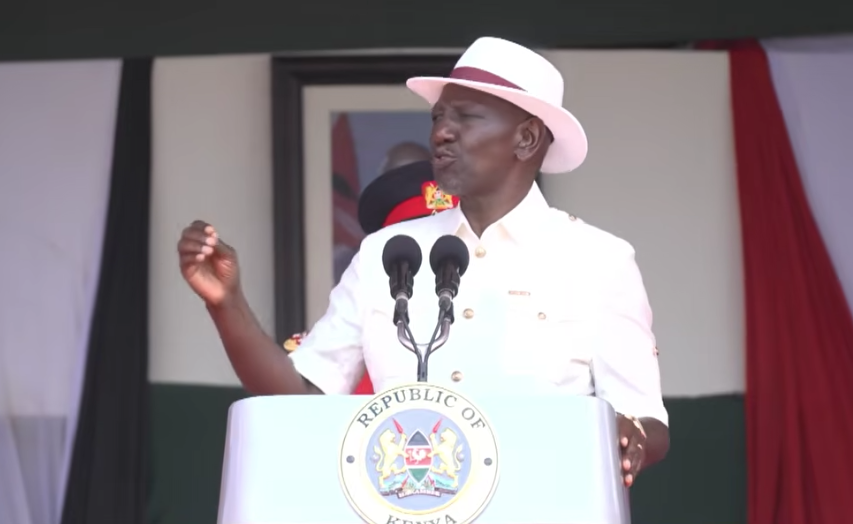
The President was speaking during an interdenominational church service in Sotik, Bomet county.
The deal with Saudi and the UAE, according to Ruto, is above board and has sorted the country’s fuel shortages that marked the start of his administration.
“When I was elected people were making long queues looking for fuel. Today no petrol stations has no fuel,” Ruto said.
The deal, he added, has also sorted local oil dealers from dollar requirement which saw most companies closing shop.
“At least 100 oil companies closed shop because they were unable to buy the dollar. It has sort out the problem of looking for dollar,” the President said.
“We have done MoU that has enabled our companies to buy in Kenya shillings and not dollar, something that has never happened.”
The President in defending the current arrangement said that neighbouring countries are currently pursuing similar arrangements, a confirmation that it is a superior deal.
“The arrangements with Saudi and UAE, today Tanzania, Uganda, Rwanda and every country today is looking for the transaction that is similar to ours.”
Ruto was accompanied by governors Hillary Barchok (Bomet), Johnson Sakaja (Nairobi), Erick Mutai (Kericho), senators Aaron Cheruiyot (Kericho), Hillary Sigei (Bomet), Jackson Mandago (Uasin Gishu), Samson Cherargei (Nandi) and a host of MPs as well as Cabinet secretaries.
His troops also chided Raila for dragging politics into the oil deal at a time the government is clearing the mess created by the handshake government.
“Raila can never be a solution to this country,” Kericho Governor Erick Mutai said.
Nairobi Governor Johnson Sakaja urged the President to focus on his transformative agenda and not to be distracted by the opposition.
“Don’t be distracted by the noise out there. No matter what do not deviate from the plan,” Sakaja said.
Oil Marketing Companies on Saturday defended the framework for the importation of fuel into the country saying the current arrangement serves Kenyans well.
The firms came out strongly to defend the G-to-G arrangement, saying it was helping to stabilise the shilling against the Dollar.
"The local cost of fuel is determined by international oil prices, the prevailing forex rate and applicable taxes. Data shows global oil prices have been steadily rising due to the global post-Covid recovery in demand and certainly more with the geopolitical challenges over the last 18 months," the marketers said.
"It is noteworthy that world prices have been rising since Quarter 2 of 2023, which coincided with the start of the G-to-G supply.''