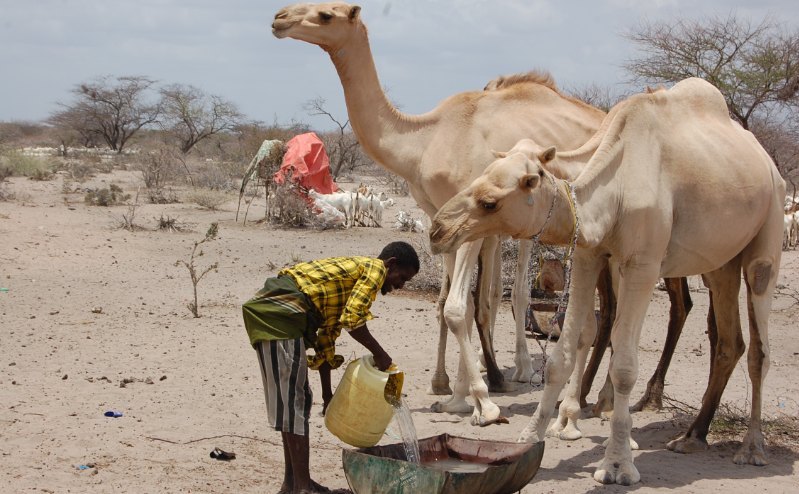
A herder gives his camels water. /SEPHEN ASTARIKO
In one of Kenya's harshest landscapes, a drought-defying camel is proving that resilience can be bred—one generation at a time.
As the country grapples with drought, the Marsabit model is emerging as a practical blueprint for climate adaptation, with plans already underway to expand the initiative to Turkana and Isiolo counties.
Pastoralist Tumal Galdibe says successful breeding depends on selecting compatible breeds to avoid calving complications and preserve the animals' resilience.
His animals produce more than six litres of milk a day, up from about four litres previously, while maintaining their ability to withstand harsh conditions.
Galdibe has spent three decades improving his Gabra camels by crossing them with Somali breeds.
The breeding programme operates through research farms, county multiplication centres and pastoralists to ensure improved genetics reach communities quickly.
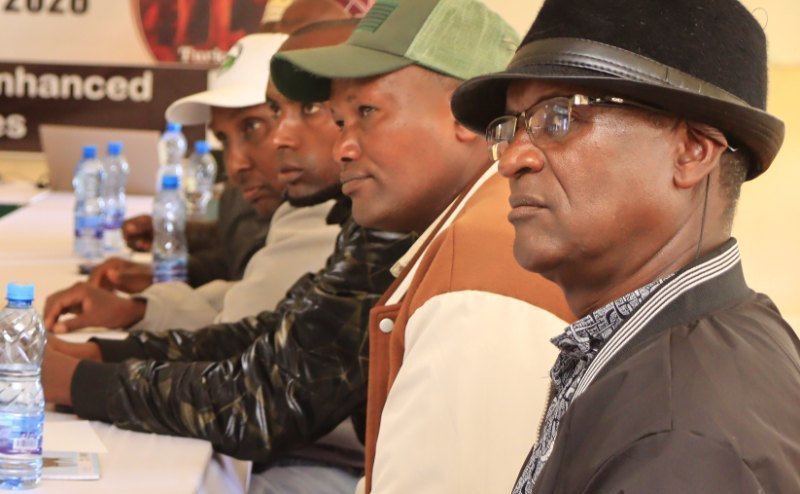 Marsabit livestock keepers are attending a county camel crossbreeding validation workshop at the KALRO county headquarters. /SEPHEN ASTARIKO
Kenya has an estimated 4.6 million camels, most of them reared in arid and semi-arid regions where climate change is making livestock farming increasingly difficult.
"This is a climate-smart solution. As arid areas expand and the population grows, the camel will become one of the country's most important livestock species," he said.
Director of Beef Research at the Kenya Agricultural and Livestock Research Organisation, Dr Tura Isacko, says better fertility, lower mortality, and increased milk and meat production will make camels central to Kenya's future food security.
As a camel specialist, he says the breeding programme is designed to improve camel productivity as demand for camel milk and meat continues to grow.
The initiative has also strengthened cooperation among neighbouring pastoralist communities, with Borana, Samburu, Gabra and Rendille herders sharing breeding stock and knowledge.
"These camels walk long distances for water and still produce milk. We are preserving our way of life, but with stronger animals," Elder Hassan Galma said.
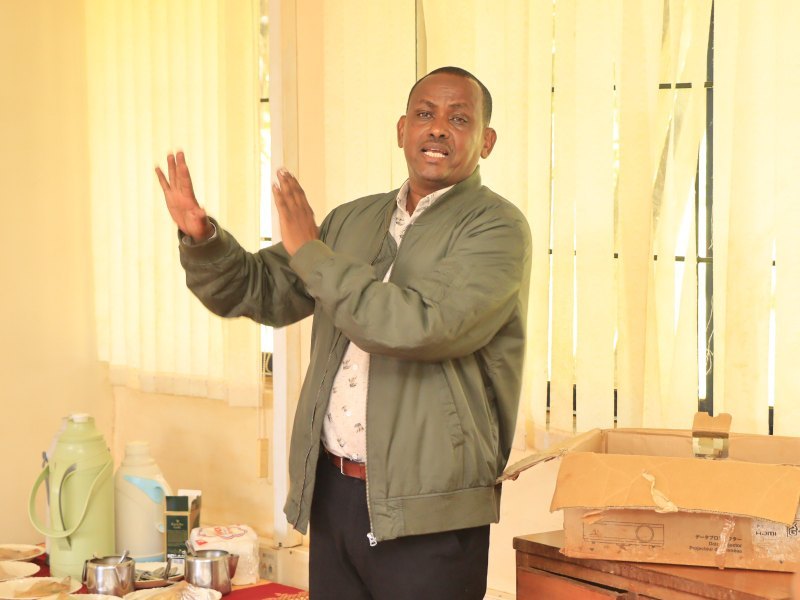 Dr Tura Isacko, Director of the Institute of Beef Research and a Camel Specialist at KALRO explains that the program is a precision breeding, not genetic modification. /STEPHEN ASTARIKO
Camel farmer Angelina Lenamuro from Laisamis believes the improved breeds will encourage pastoralists to keep fewer but more productive animals instead of maintaining large herds.
Women remain at the heart of the camel value chain. Although men traditionally own the animals, women are responsible for milking, processing and marketing the milk.
For Amina Jillo, one of the group's leaders, camel milk sales paid her daughter's secondary school fees after she excelled in her exams.
The Watiti Women's Dairy Group in Laisamis now earns about Sh50,000 every month from milk sales, enabling members to educate their children and improve household incomes.
The increased milk yields are already changing lives.
"Every mating is carefully planned to produce animals that are more resilient, productive and better suited to the changing climate," he said.
Speaking on the sidelines of a camel crossbreeding validation workshop at KALRO's Marsabit offices, attended by livestock keepers, the programme's lead geneticist, Samuel Wako, said the goal is not to replace indigenous camels but to improve them.
In Korr alone, more than 120 hybrid calves have been born over the past 18 months. Increased milk production has also enabled women's groups to sell surplus milk to cooperatives at about Sh100 per litre.
The results have been striking. First-generation hybrids now produce between eight and 10 litres of milk a day—up to five times more than local breeds.
Rather than importing foreign breeds, the Marsabit Camel Crossbreeding Initiative trains community breeding champions to identify elite local females and mate them with high-performing crossbred sires using performance records and, where possible, artificial insemination.
KALRO scientists found that carefully crossing selected indigenous camel breeds could significantly increase productivity without sacrificing the resilience that makes camels indispensable in arid lands.
When the devastating 2022–2023 drought swept across northern Kenya, many pastoralists lost large portions of their herds, pushing families deeper into food insecurity.
For generations, the Rendille and Gabra communities have relied on the hardy Somali camel. Although well adapted to harsh conditions, the breed produces only one to two litres of milk a day during drought—often barely enough to feed a household.
By combining modern genetics with indigenous knowledge, the initiative aims to produce camels that are drought-resilient, disease-tolerant and highly productive.
The transformation is being driven by a pioneering camel crossbreeding programme spearheaded by KALRO in partnership with local pastoralists.
The improved camels produce up to five times more milk than traditional breeds, even during prolonged dry spells, giving families a reliable source of food and income when other livestock struggle to survive.
It is unfolding not in laboratories, but on the rangelands, where a new generation of crossbred camels is transforming the fortunes of pastoralist communities.
In the drought-scorched plains of Marsabit County, where livestock carcasses have become a grim symbol of climate change, a quiet revolution is taking shape.
INSTANT ANALYSIS
The Marsabit camel crossbreeding initiative demonstrates how climate adaptation can move beyond emergency relief to long-term resilience. As recurrent droughts continue to undermine traditional livestock production, improving indigenous camel breeds offers pastoralists a practical way to safeguard livelihoods without abandoning their cultural heritage. Higher milk yields translate into better household nutrition, increased incomes and greater financial independence for women, while reducing the pressure to maintain large herds. If scaled sustainably, the programme could strengthen food security across Kenya's arid and semi-arid lands. Its success shows that locally driven innovation, backed by scientific research, can help communities adapt to a changing climate.
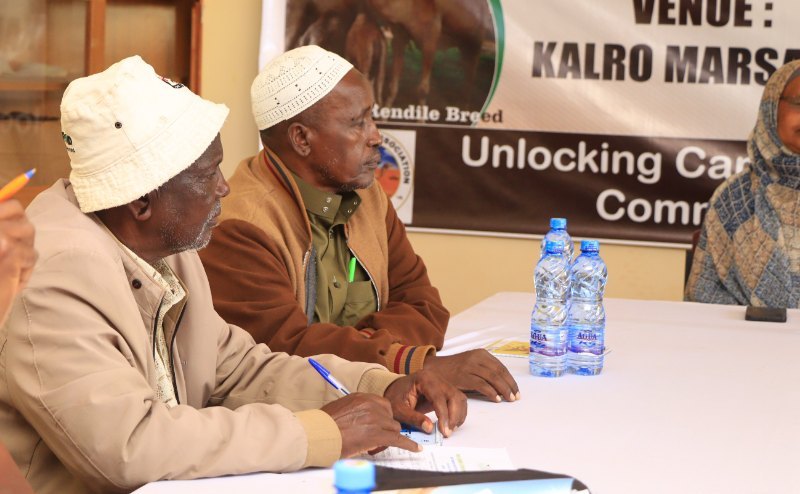 Marsabit livestock keepers attending a county camel
crossbreeding validation workshop at the KALRO county headquarters./STEPHEN ASTARIKO
Marsabit livestock keepers attending a county camel
crossbreeding validation workshop at the KALRO county headquarters./STEPHEN ASTARIKO