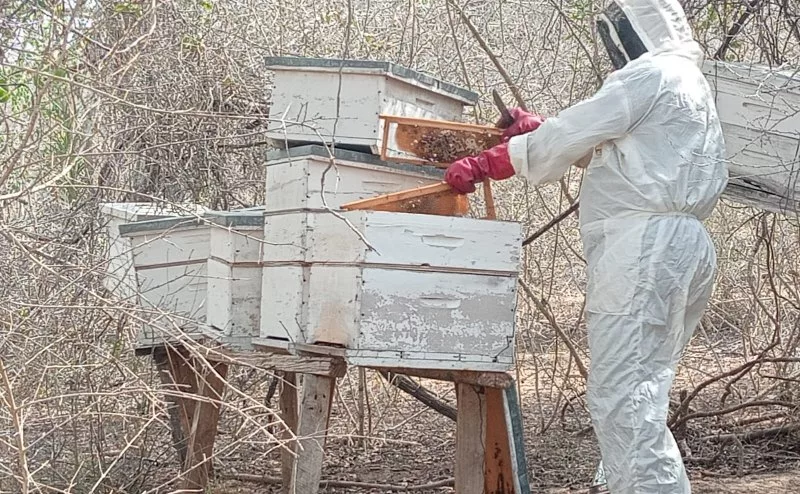
Every jar of honey tells a story. But for many Kenyan beekeepers, that story is increasingly being overshadowed by one problem—adulteration.
As fake and diluted honey finds its way onto the market, consumers are losing confidence in the product, leaving genuine producers struggling to earn fair returns despite the country's vast potential to become a leading honey producer.
Experts now say protecting the identity of Kenyan
honey through geographical indication could restore consumer trust, guarantee
quality and enable beekeepers to command premium prices while opening new
opportunities for women and young people.
Kenya currently produces between 17,000 and 19,000
tonnes of honey annually, far below its estimated production potential of
100,000 tonnes.
According to Prof John Mburu of the University of
Nairobi's Department of Agricultural Economics, establishing a geographical
indication for honey would help assure buyers of the product's quality, safety
and authenticity while curbing adulteration through traceability.
"Geographical Indication can be an economic
tool for youth and women as it increases prices, offsets costs and leads to
higher profits," Mburu said.
He said that
imported honey often fetches nearly twice the price of locally produced honey,
largely because consumers associate it with higher quality and assured
standards.
A GI identifies a
product as originating from a specific region or territory whose unique
characteristics give it a distinct reputation. The label signals authenticity,
quality and safety while making it easier to trace products back to their
source.
Mburu said protecting honey through GI should go hand in hand with strengthening market
access to ensure producers reap the benefits.
He also called for deliberate efforts to expand the role of women along the honey value chain, noting that many are already involved in processing, packaging and marketing but lack adequate infrastructure.
"Women need aggregation and processing hubs so
they can benefit more from the value chain," he said.
At the same time, he urged policymakers and
communities to confront deep-rooted cultural practices that continue to lock
women out of honey production.
In many Kenyan communities, studies have shown that women are traditionally discouraged from harvesting honey or placing log hives high in trees because the activities are viewed as physically demanding or culturally inappropriate.
Climbing trees and handling bees remain taboo in
some sub-cultures, discouraging many women from actively participating in
beekeeping.
Mburu said that in some cases, women only participate in selling honey and are expected to share the proceeds with men, limiting their economic independence.
He added that many young people also perceive
beekeeping as labour-intensive, making it less attractive despite its economic
potential.
The experts spoke during the Kenya-France Youth and Innovation Day held at the University of Nairobi on July 14.
The event was organised by the French Embassy in Kenya in partnership with the University of Nairobi and the French-Kenyan Chamber of Commerce.
Building on the momentum of the Africa Forward
Summit, partly hosted by the university in May, the forum highlighted
collaborations that link education, research, innovation, entrepreneurship and
employment opportunities for young people.
The French Embassy is supporting a GI project for Mau Forest honey in partnership with the Mariashoni Community Development Cooperative, International Centre of Insect Physiology and Ecology and French agricultural research organisation Cirad.
The initiative aims to develop a GI label for Mau Forest honey, guaranteeing its quality while helping local beekeepers secure better prices in domestic and international markets.
It also
promotes biodiversity conservation, documents traditional log-hive beekeeping
methods and trains local producers.
Dr Sevgan Subramanian, a principal scientist at Icipe, said Kenya possesses enormous untapped potential in honey production but warned that the industry's future depends on protecting the ecosystems that sustain bees.
"Honey production is linked to how we protect
ecosystems and manage them," he said.
He added that a GI would enhance the value of African honey both
locally and internationally while encouraging younger generations to acquire
beekeeping skills.
The experts also urged greater investment in value
addition to maximise returns from the sector.
For Clare Rono, an Ogiek native and member of the
Mau Forest Women Cooperative, empowering women could unlock much of the
industry's untapped potential.
She said many women remain excluded because they do
not own land, making it difficult for them to establish or manage beekeeping
enterprises.
Rono believes removing the cultural and structural
barriers facing women would not only increase honey production but also
strengthen their economic independence, allowing more families to benefit from
one of Kenya's oldest forest-based livelihoods.