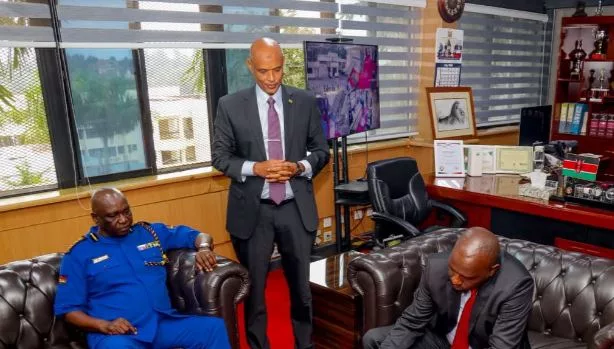
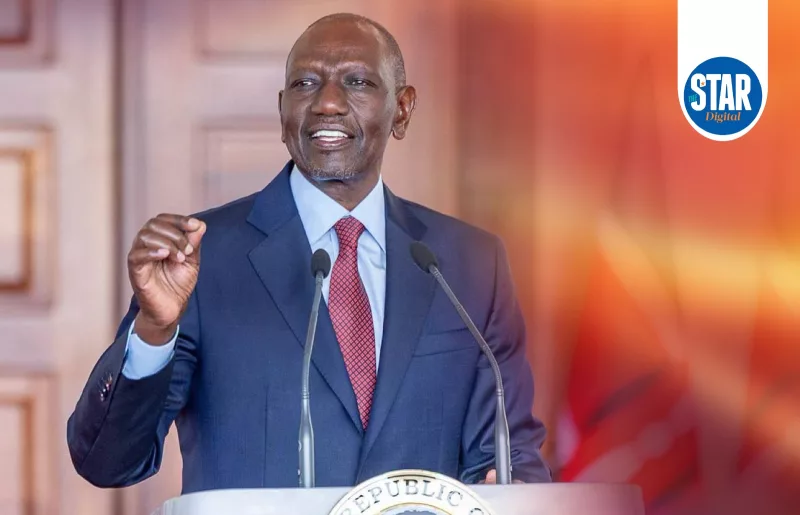
 Following Tuesday’s approval by the Nairobi City County Executive Committee, Dr Silvester Kasuku, Advisor on Governance in the Executive Office of the President, also met Roads Principal Secretary Eng. Joseph Mbugua to brief him on the Nairobi Metropolitan Mass Rapid Transit System (NMRTS) and discuss the way forward. /HANDOUT
The Nairobi Metropolitan Mass Rapid Transit System (NMRTS) gained fresh momentum on Wednesday after senior national government officials met to advance implementation plans.
The development comes just a day after the Nairobi City County Executive Committee, chaired by Governor Johnson Sakaja, approved the landmark transport project.
Dr Silvester Kasuku, Advisor on Governance in the Executive Office of the President, held a working meeting with Transport Principal Secretary Mohammed Daghar to brief him on the project and chart the next steps towards its implementation.
The meeting underscored the growing collaboration between the national government and Nairobi City County in delivering what is expected to be one of Kenya's most ambitious urban transport investments.
Dr Kasuku also held a working meeting with Eng. Joseph Mbugua, CBS, Principal Secretary for the State Department for Roads, to brief him on the Nairobi Metropolitan Mass Rapid Transit System (NMRTS).
 Following Tuesday’s approval by the Nairobi City County Executive Committee, Dr Silvester Kasuku, Advisor on Governance in the Executive Office of the President, met Transport Principal Secretary Mohammed Daghar to brief him on the Nairobi Metropolitan Mass Rapid Transit System (NMRTS) and discuss its implementation./HANDOUT
The project concept, approved by the County Executive Committee on Tuesday, is the product of a strategic partnership between the Office of the Chief of Staff and Head of the Public Service in the Executive Office of the President and the Office of the Governor, Nairobi City County.
The initiative seeks to establish a modern, integrated, safe, and sustainable mass rapid transit network that will transform mobility across the Nairobi Metropolitan Area.
Designed to address Nairobi's chronic traffic congestion, the NMRTS is expected to reverse annual economic losses currently estimated at Sh130 billion, with congestion costs projected to exceed KSh1 trillion annually by 2063 if no major intervention is undertaken.
The rail network is also expected to reduce the two-and-a-half to three-and-a-half hours many Nairobi commuters spend in traffic each day by introducing fast, reliable, and high-capacity rail services.
The resulting reduction in travel times is projected to recover productivity losses estimated at Sh53 billion annually, equivalent to nearly 68,000 full-time jobs and approximately 0.9 per cent of Nairobi's Gross Domestic Product (GDP).
Beyond easing congestion, the NMRTS is expected to stimulate economic growth through Transit-Orientated Development (TOD), attract private sector investment, reduce logistics costs, create thousands of jobs, and enhance land values, further strengthening Nairobi's position as East Africa's premier financial, commercial, and innovation hub.
The project also promises significant environmental and social benefits, including lower greenhouse gas emissions, reduced dependence on private vehicles, and cleaner urban air through reduced transport-related pollution.
Officials said the system will provide safe, affordable, reliable, and accessible public transport while improving road safety, reducing commuter stress, and enhancing the overall quality of life for millions of residents.
The long-term transport plan is designed to support Nairobi's rapidly expanding population, projected to grow from 5.1 million today to approximately 11.5 million by 2063, while accommodating an increase in daily travel demand from 12–13 million trips to 33–36 million trips over the same period.
Nairobi Governor Johnson Sakaja described the NMRTS as more than a transport project, saying it is a transformative national development programme that will unlock productivity, catalyse investment, strengthen regional competitiveness, and advance the Bottom-Up Economic Transformation Agenda (BETA), Kenya Vision 2030, and the African Union's Agenda 2063.
The NMRTS is poised to become a defining legacy infrastructure project, laying the foundation for a world-class metropolitan transport system that will reshape Nairobi into a more connected, productive, sustainable, and globally competitive city.