Teachers urged to embrace virtual laboratories to boost STEM learning
Official says Virtual laboratories will improve access to practical learning, enhance learners' understanding of scientific concepts
by HILTON OTENYO
Audio By Vocalize
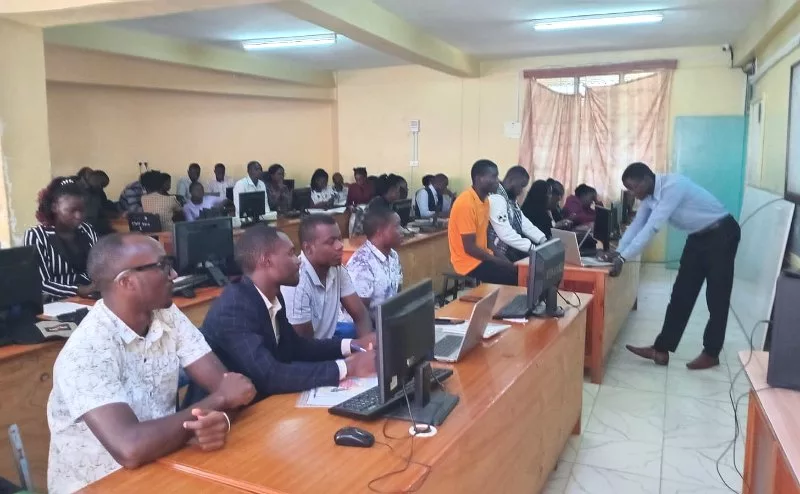
Teachers in Vihiga attending training in virtual laboratories organised by the Centre for Mathematics, Science and Technology Education in Africa (CEMASTEA) at Bunyore Girls High School/IMAGE /HILTON OTENYO
Junior School Science, Technology, Engineering and Mathematics (STEM) teachers have been challenged to embrace virtual laboratories.
The move seeks to improve teaching and bridge the gap created by inadequate laboratory facilities in many schools.
The Centre for Mathematics, Science and Technology Education in Africa (CEMASTEA) is currently training Junior School teachers on the use of virtual laboratories.
This is expected to enhance practical learning in schools with limited or inadequate science laboratory facilities.
The training seeks to equip teachers with digital skills to integrate virtual laboratories into the teaching of Mathematics and Integrated Science under the Competency-Based Education (CBE) curriculum.
The lobby argues that this will improve the teaching of Mathematics and Science in schools with inadequate facilities.
Under the programme, teachers are trained on the CEMASTEA e-learning platform, the development of virtual lessons and the integration of practical work into STEM instruction.
They are then expected to mentor at least three colleagues in their respective schools before qualifying for certification.
Speaking during the training of teachers in Luanda, Vihiga county, Luanda Subcounty Teachers Service Commission (TSC) director Florian L'Linga said the programme would bridge the gap in practical learning, especially in schools lacking fully equipped laboratories.
"Virtual laboratories will improve access to practical learning, enhance learners' understanding of scientific concepts and ultimately improve performance in STEM subjects," he said.
Studies conducted in 2023 and 2024 established that many Junior Schools continue to face challenges due to inadequate STEM teaching resources and limited laboratory facilities.
The agency said virtual laboratories are intended to complement, rather than replace, physical laboratories by allowing learners to safely conduct experiments, explore scientific concepts and repeat practical activities regardless of their school's resources.
CEMASTEA monitoring executive Peter Lekakemy challenged teachers to embrace digital technologies and ensure the newly acquired skills translate into improved classroom experiences.
"The success of this programme will depend on how effectively teachers integrate virtual laboratories into everyday teaching. Technology should be used to make learning more engaging and meaningful," he said.
Speaking on behalf of the participants, CEMASTEA Cohort President Boniface Lizanga said the training had strengthened teachers' capacity to integrate technology into STEM lessons.
"The knowledge and practical skills we have acquired will help us make science lessons more interactive and learner-centred. We are committed to mentoring our colleagues and ensuring learners benefit from this innovation," he said.