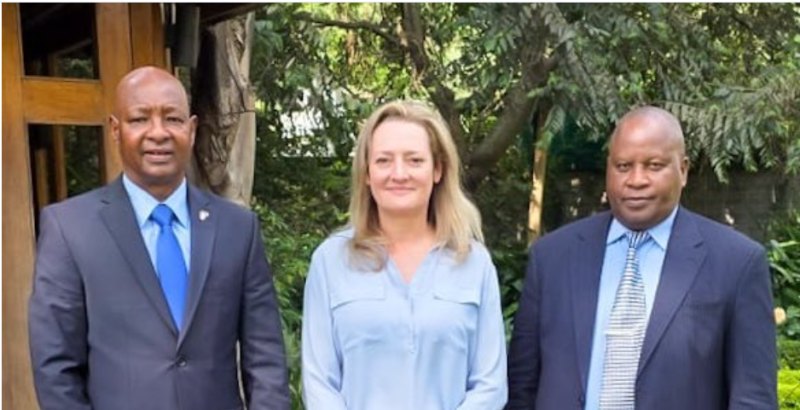
 Agriculture and Livestock Development CS Mutahi Kagwe during the handover of milk coolers to Wakulima Dairy Farmers Limited in
Mukurweini, Nyeri County./HANDOUT
Agriculture and Livestock Development CS Mutahi Kagwe during the handover of milk coolers to Wakulima Dairy Farmers Limited in
Mukurweini, Nyeri County./HANDOUT
Dairy farmers have been urged to shift their focus from producing more milk to producing better-quality milk as the government moves to introduce quality-based payment systems that will reward farmers with higher prices for cleaner and safer milk.
Agriculture Cabinet Secretary Mutahi Kagwe said the future of Kenya's dairy industry lies in quality production, noting that farmers who adopt modern dairy practices will earn more and access better markets.
"As quality-based milk payment becomes the new standard, farmers who embrace best dairy practices, invest in herd management and work together through strong cooperatives will be best positioned to benefit from higher earnings, expanded market access and the growing opportunities in value-added dairy products," Kagwe said.
The CS spoke during the handover of milk coolers to Wakulima Dairy Farmers Limited in Mukurweini, Nyeri county.
Mary Wanjiku, a dairy farmer from Mukurweini and a member of Wakulima Dairy Farmers Limited, welcomed the quality-based payment system, saying it would motivate farmers to improve production standards.
"For many years we have been paid mainly according to the litres delivered. If quality earns us a better price, we will be more careful about hygiene, feeding and milk handling because it directly increases our income," she said.
Another farmer, Joseph Maina, said the new milk coolers would significantly reduce spoilage, especially during the hot season.
"There are times we have lost money because milk went bad before reaching the processor. With the cooling facilities nearby, we expect less wastage, better quality and improved prices. That gives farmers confidence to invest more in dairy farming," he said.
He said quality is no longer just a production standard but is increasingly becoming the currency of Kenya's dairy industry.
According to the Kenya Dairy Board, Kenya remains Africa's leading milk producer, with annual production estimated at about 5.4 billion litres. However, Kagwe said the country's next milestone is not simply increasing production but consistently producing milk that meets high-quality standards.
He noted that under the upcoming Quality-Based Milk Payment (QBMP) system, farmers will increasingly be paid according to the quality of milk they deliver rather than the quantity supplied.
The new payment model is expected to encourage dairy farmers to improve animal nutrition, maintain clean water supplies, strengthen disease control, seek regular veterinary services, observe hygienic milking practices and ensure proper milk handling.
"Milk with lower bacterial counts, free from adulteration and antibiotic residues, and with higher butterfat and protein content commands greater value in both local and international markets," Kagwe said.
He added that the government is investing in infrastructure to help farmers preserve milk quality and reduce post-harvest losses.
"Milk coolers are more than storage facilities. They are quality preservation investments. By rapidly cooling milk after collection, they reduce bacterial growth, maintain freshness, minimise spoilage and enable farmers to consistently supply milk that meets premium quality standards," he said.
So far, 32 milk coolers have been distributed across Nyeri county, benefiting cooperatives including Iriaini, Tekari, Gakindu, Gataragwa and Naromoru.
The CS also challenged the dairy sector to move beyond selling raw milk by embracing value addition through products such as cheese, yoghurt, butter and milk powder.
"Producing processed dairy products will enable Kenya to penetrate export markets, create more jobs, reduce losses during periods of surplus production and ultimately increase farmers' incomes," he said.
He added that strong cooperative societies remain critical in helping farmers access financing, extension services, quality assurance systems and better markets while lowering production costs through economies of scale.
To boost dairy productivity, Kagwe announced the distribution of 500 doses of sexed semen through the Kenya Dairy Board, saying the technology gives farmers up to a 90 per cent chance of producing calves of the desired gender, thereby accelerating herd improvement.
Farmers also received 70,000 coffee seedlings, 70,000 avocado seedlings and 50,000 macadamia seedlings to diversify their income and improve agricultural productivity.