

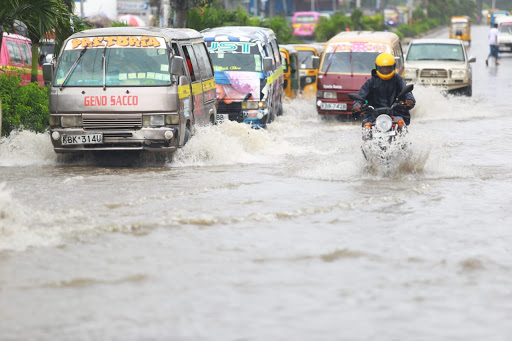
 Vehicles wade through flooded roads/FILE
Nairobi and several other parts of Kenya could experience morning showers and cloudy conditions over the next five days, even as most of the country remains largely dry, according to the latest weather forecast.
The Meteorological Department's five-day forecast covering June 18 to 22 indicates that while dry weather will dominate much of the country, some regions, including Nairobi, could receive light rainfall, particularly in the afternoons and mornings.
Acting Director of Meteorological Services Edward Mwangi said the overall outlook remains largely dry.
"Most parts of the country are likely to be generally dry. Rainfall is mainly expected over the Coast, the Rift Valley, the Lake Victoria Basin and the Highlands West and West of the Rift Valley," Mwangi said in the forecast.
"Intermittent cool and cloudy conditions are expected in
some parts of the Highlands East and West of the Rift Valley, the Southeastern
Lowlands, the Rift Valley and Northeastern Kenya."
The Highlands East of the Rift Valley region, which includes Nairobi, Kiambu, Murang'a, Nyeri, Kirinyaga, Laikipia, Meru, Embu and Tharaka Nithi counties, is expected to experience cloudy mornings breaking into sunny intervals throughout the period. The forecast also shows a possibility of showers over a few places on the first three days with showers returning in some areas on Monday.
Temperatures in Nairobi and neighbouring counties are expected to remain relatively cool, with daytime temperatures ranging between 25 and 28 degrees celsius and night-time temperatures dropping to as low as four degrees celsius.
The Coast could receive the most consistent rainfall during the period. Meteorologists expect showers over a few places during most mornings and afternoons, particularly from Saturday through to Monday.
Western Kenya, the Lake Victoria Basin and parts of the Rift Valley are also expected to receive afternoon showers and thunderstorms over a few places throughout the five-day period.
The latest forecast comes just days after the department warned that the country is entering a prolonged dry phase ahead of the possible development of a moderate to strong El Niño later in the year.
In a climate outlook released earlier this month, the department said Kenya is likely to experience largely dry and warmer-than-normal conditions during June, July and August, before potentially enhanced rainfall arrives during the October-November-December short rains season.
According to the department, there is an 80 to 82 per cent probability that El Niño conditions will persist during the June-July-August period, with the likelihood increasing to between 90 and 96 per cent towards the end of the year.
"Most models suggest the event will be at least moderate, and possibly strong," Mwangi said in the earlier statement.
The weather phenomenon is caused by unusual warming of sea surface temperatures in the central and eastern Pacific Ocean and is known to alter rainfall patterns across many parts of the world, including East Africa.
For now, however, the dominant weather story remains dryness.
The June-July-August seasonal forecast shows near-average to below-average rainfall across the Highlands West of the Rift Valley, the Lake Victoria Basin, the Rift Valley and north-western Kenya. Much of the south-eastern lowlands and north-eastern Kenya are expected to remain generally sunny and dry.
The department is also monitoring developments in the Indian Ocean Dipole (IOD), another climate driver that can significantly influence Kenya's rainfall patterns.
Meteorologists say that if a positive IOD develops later in the year and coincides with El Niño conditions, the country could experience enhanced rainfall during the short rains season.
"The combined effects of El Niño and a positive IOD significantly influence rainfall patterns over Kenya, potentially leading to enhanced rainfall during the October-November-December season," Mwangi warned in the earlier climate update.
Kenya has experienced devastating El Niño-related flooding in the past. The 2023-24 El Niño season caused widespread flooding, deaths and destruction of infrastructure across several counties, while the 1997-98 event remains one of the most severe weather disasters in the country's history.
The Kenya Meteorological Department is expected to release its detailed October-November-December seasonal forecast in late August or early September.
Instant analysis
The forecast highlights the growing challenge of weather variability in Kenya, where short-term dry conditions can coexist with warnings of heavier rainfall later in the year. While the immediate outlook points to generally dry weather, the possibility of a moderate to strong El Niño and a positive Indian Ocean Dipole raises concerns for disaster preparedness, agriculture and water resource management. The forecast serves as an early warning for county governments, farmers and emergency agencies to plan ahead. Kenya's recent experience with destructive floods underscores the importance of closely monitoring climate developments and strengthening resilience to extreme weather events.




![[PHOTOS] Uhuru graces commissioning mass of Catholic Women](https://cdn.radioafrica.digital/image/2026/06/0bbd7e96-f180-4e02-966f-97c3fb201478.jpg)