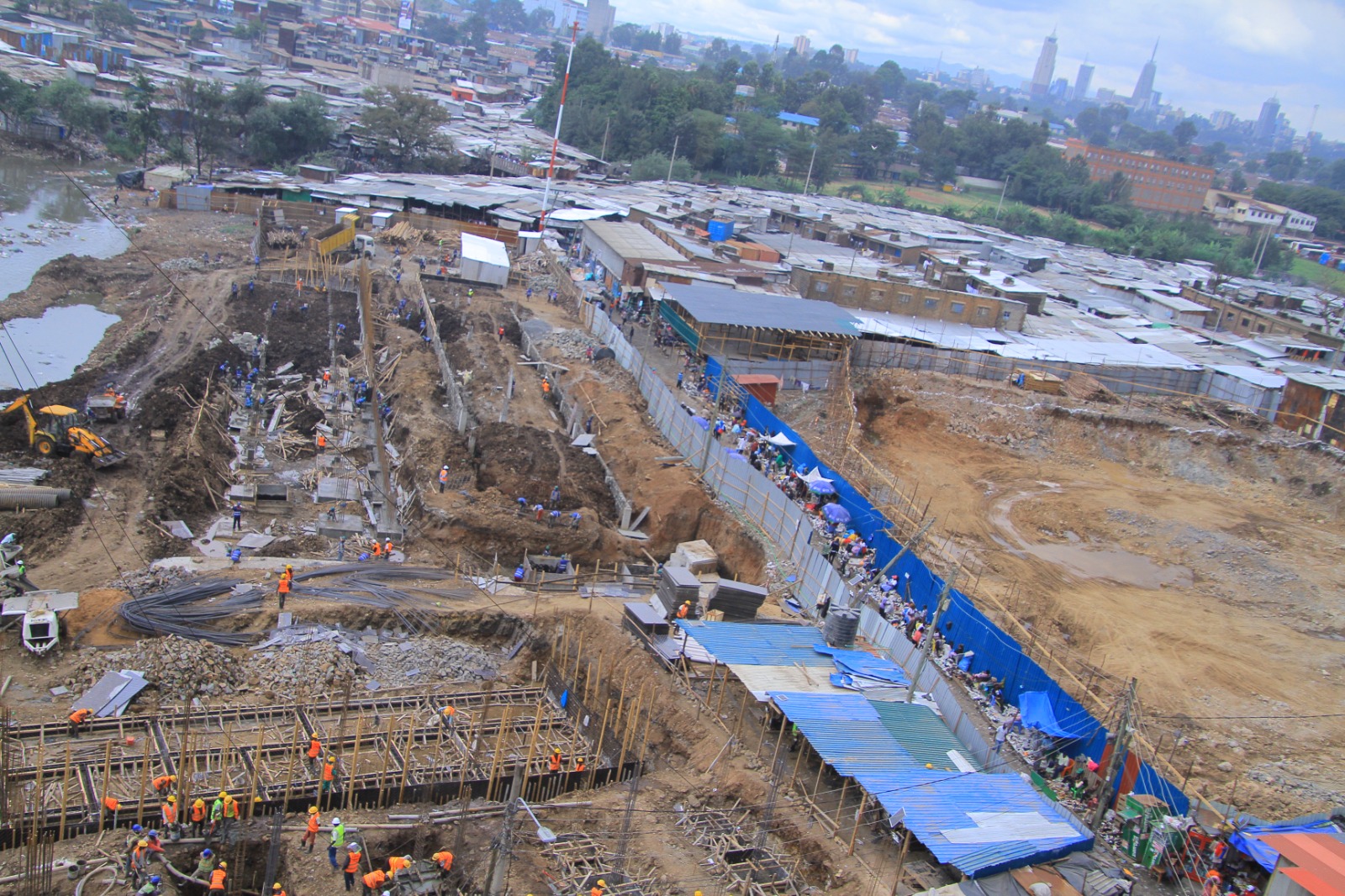
 Gikomba market under construction /EZEKIEL AMING'A
Under the scorching afternoon sun at Kamukunji Grounds, Jane Wanjiku stands behind neatly arranged piles of second-hand clothes, her voice rising above the noise of bargaining customers.
“Kamera! Kamera! Mia mbili! Mia mbili!” she shouts,
advertising dresses selling for Sh200 as shoppers sift through the garments in
search of bargains.
For Wanjiku, this is more than just a business. It is a
lifeline.
The 52-year-old widow has spent the last 22 years trading at the Gikomba market, Nairobi's sprawling hub known for its vibrant
second-hand clothing trade.
Through the business, she has raised her children
single-handedly, paid school fees and built a life.
“Gikomba is my everything,” she says, pausing briefly to
attend to a customer.
“When my husband died, I had to find a way to take care of
my children. This business gave me that opportunity.”
Today, one of her children is a lawyer while another is a
university graduate — achievements she proudly attributes to the market that
has sustained her family for more than two decades.
But Wanjiku is among 14,400 traders who have recently been
relocated from the old Gikomba market along the Nairobi River to pave the way
for the construction of a modern market complex.
While the move has disrupted business, she believes the
sacrifice will be worth it.
For years, Gikomba traders have lived with the constant fear
of losing everything to devastating fires that have repeatedly swept through
the market.
“It has always been a struggle,” she says. “One day you are
making sales, the next day you are running to save your stock from a fire.”
The memories remain painful.
At one point, she lost her entire investment when flames
consumed her stall, reducing thousands of shillings worth of merchandise to
ashes within minutes.
“There is nothing as painful as watching everything you have
worked for burn before your eyes,” she recalls.
Besides fires, traders have also endured frequent
confrontations with government agencies over environmental concerns linked to
the market's location along the Nairobi River.
“The market is next to the river. Sometimes we would have
issues with Nema, other times county enforcement officers or water authorities.
It felt like we were always fighting one battle or another,” she says.
That is why the prospect of moving into a modern market
brings hope.
“I am happy because we will not have fires in the new
market. It will be orderly and organised. We will no longer be fighting county
officers or environmental agencies,” she says with a smile.
Wanjiku currently operates from Kamukunji Grounds, which accommodates
about 7,000 traders displaced by the redevelopment project.
Another group of traders is expected to move to a temporary
site near the Kenya Meat Commission.
The relocation is part of an ambitious Sh5 billion project
being jointly implemented by the national government and Nairobi county
government to transform Gikomba into a modern trading centre.
The market forms part of a broader cooperation agreement
between the two levels of government aimed at investing about Sh80 billion in
infrastructure and urban renewal projects across Nairobi.
Beyond addressing perennial fires, the project seeks to
restore order, improve working conditions and support efforts to rehabilitate
the heavily polluted Nairobi River.
“Gikomba is not just a market. It is one of the biggest
economic engines in Nairobi,” says Gikomba Market Traders Association chairman
Mbugua Kibathi.
“About 10 to 15 per cent of the county's GDP is generated in
Gikomba. Gikomba is one of the biggest wheels that keeps this city moving.”
The construction of the market will be
undertaken in four phases.
The first phase, currently under construction, is expected
to cost about Sh800 million and accommodate about 7,000 traders. It is
scheduled for completion by January next year.
A visit to the site reveals a hive of activity. Workers are
busy carrying out excavation works, erecting pillars and laying heavy steel
structures in preparation for the construction of the main building.
“The excavation has taken time because the site is next to a
river and we have experienced heavy rains,” Kibathi explains. “The contractors
are taking their time to ensure the structure is safe and durable.”
The project is being supervised by the Kenya Defence Forces.
Once complete, the first phase will consist of a multi-level
structure with a sub-basement, basement and several upper floors designed to
accommodate traders in a safer and more organised environment.
The facility will feature secure trading stalls, cold rooms
for traders dealing in perishable goods, modern sanitation facilities, ICT
hubs, basement parking and even a day-care centre to support working parents.
The remaining three phases, estimated to cost about Sh3.8
billion, will accommodate thousands more traders.
The second phase is expected to host 3,000 traders, while
subsequent phases will create additional space for more than 3,000 others.
For many traders, the development represents a long-awaited
solution to problems that have plagued Gikomba for decades.
“When all these phases are complete, there will be no mud,
no chaos and no endless fires,” Kibathi says. “This is the beginning of a new
chapter for Gikomba.”
He dismisses concerns that traders relocated from the old
market may lose their spaces once the project is completed.
“All traders have been enumerated and registered,” he says.
“Those who were operating in the old market will be given priority. Nobody from
outside will get a stall before the original traders.”
Kibathi further says traders will not be required to pay rent
for the stalls, although discussions are ongoing with Nairobi County regarding
licensing fees.
“We want a system that is fair and affordable. Our goal is
to agree on an annual licensing arrangement instead of the current frequent
collections that burden traders,” he says.
INSTANT ANALYSIS
The story highlights the resilience and optimism of Gikomba traders as they transition from a market long plagued by fires, poor infrastructure and environmental disputes to a planned modern trading complex. Through the experiences of trader Jane Wanjiku, it humanises the impact of the redevelopment project on thousands of livelihoods. The article also underscores Gikomba’s critical role in Nairobi’s economy while presenting the Sh5 billion redevelopment as a solution to longstanding challenges, promising safer, organised and more dignified working conditions for traders.


![[PHOTOS] Obado Leaves court in handcuffs](https://cdn.radioafrica.digital/image/2026/07/efc75d55-2eb9-4019-bb24-937dc4fc4f56.webp)