129 wildlife species killed along Nairobi-Mombasa road last year
Mbithi said KWS recently tagged 10 giraffes across the hotspots, specifically in Lukenya Maanzoni and Kapiti/Konza areas
by The Star
Audio By Vocalize
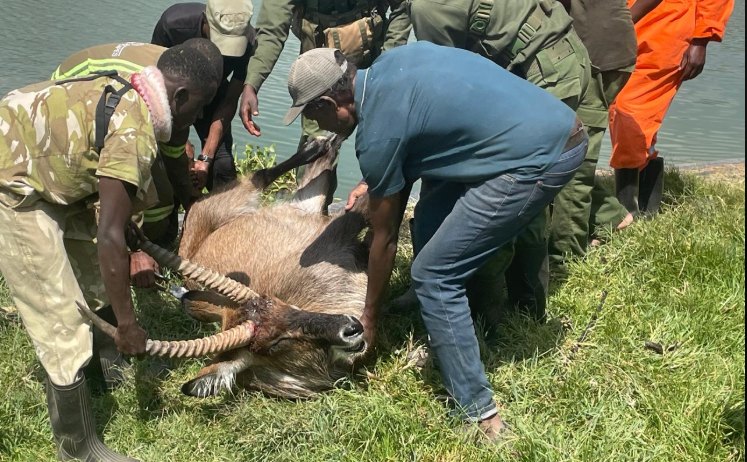
A security officer looks at a girrafe knocked down by a vehicle along Nairobi-Mombasa road.
Image: HANDOUT.
At least 129 wildlife species were killed along the busy Nairobi-Mombasa Highway last year.
Athi-Kapiti Wildlife Conservancies Association says the highway is becoming a death trap for wildlife.
“On Mombasa Road between Green Park and Malili town, the most affected species include giraffes, zebras, wildebeests, spotted hyenas, striped hyenas, hartebeests, elands, serval cats, aardwolf, impalas, cheetahs, grant gazelles, thompson gazelles and African wild dogs,” Athi-Kapiti Wildlife Conservancies Association board member Michael Mbithi said.
Mbithi says 10 giraffes, 89 Zebras, 13 wildebeests, five hyenas, five hartebeests, two elands, and one serval cat; one aardwolf and three impalas are documented by KWS to have been killed last year.
A wild animal killed along Nairobi-Namanga highway. Image: COURTESY.
The killings, he says, have been between Green Park and Kyumbi.
In total, 129 different wildlife species were killed in 2022.
Efforts to reach KWS acting Director General Erustus Kanga failed as he neither picked our calls nor answer our text messages.
The Athi-Kapiti Wildlife Conservancies Association is a membership organisation bringing together diverse conservancies and ranches to champion community-led conservation across 4,000 square kilometres of the Athi-Kapiti ecosystem.
The ecosystem allows the seasonal movements of wildlife from Nairobi National Park to Amboseli, Ol Donyo Sabuk, Tsavo, and Serengeti National Parks.
Mbithi, an honorary warden with the Kenya Wildlife Service, said the rate at which wildlife is being killed by speeding vehicles is alarming.
He said the killings occur mostly at night when the wildlife is either crossing or grazing on fresh grass by the roadside.
He said there should be bumps and rumble strips at designated areas like the Voi Taveta road, signage warning motorists to be vigilant of wildlife and slow down, fencing the highway and letting the wildlife and livestock use designated crossing points, especially overpasses and underpasses, street lighting and grass cutting on the lip and centre of the highway.
On who bears the responsibility when such killings occur, Mbithi said the wildlife is most of the time hit by large trucks and many times meat is taken.
“In a few incidences, the accidents are major and the vehicles written off and people hospitalised. These are treated as normal traffic accidents but are kept hidden from public scrutiny,” he said.
He said the buck stops with NTSA who should be responsible for road safety and KeNHA being responsible for road design, construction and maintenance.
Mbithi said KeNHA is also to blame for not including wildlife and livestock crossing into their design and construction despite this area being a wildlife and livestock corridor.
He said KeNHA should highlight the danger to human life, property, and death of wildlife and livestock along the corridor so that measures can be instituted.
Mbithi said bumps and rumble strips were prohibited due to this being a major highway.
“Signage has taken us over three months to get approval on. And we are yet to get a fully attended dedicated meeting with KWS, KeNHA, NTSA, Athi Kapiti landowners and the County Commissioners office despite attempts by the local warden to put this together,” he said.
Mbithi said KWS recently tagged 10 giraffes across the hotspots along Mombasa Road, specifically in Lukenya, Maanzoni and Kapiti/Konza areas.
These tags will help track different herds of giraffes and document crossing points and help wildlife responders keep the animals away from the highway.
A source from KeNHA said their work is to do the highways.
“In issues road safety, NTSA comes in and KWS comes in in issues to do with conflicts with wildlife,” the source who requested anonymity said.
Mbithi said the local landowners with support from Save the Giraffe Now made six signs and after three months, got a permit to install two signs.
He said KeNHA saw the sign, and liked it and approved the rest.
“Unfortunately the signs were stolen within 24 hours. The Athi Kapiti landowners are now working on plastic signage that will have no value to scrap dealers,” he said.
Mbithi said the biggest threats to wildlife apart from poaching are habitat loss, human-wildlife conflict and now linear infrastructure that either disrupts migration corridors affecting access to water and pasture and in the long term species genetics and now causing mass killings of rare and threatened species by road kills.
He said the human-wildlife conflict has been highlighted due to the human aspect but linear infrastructure has been left out.
“This in my view needs a policy on design and construction that takes wildlife crossings into account. What has been kept under wraps is the cost of human injuries, death and property loss in the accidents that occur. This issue needs to be prioritised together with the wildlife corridors issue.”
Scores of wildlife have also died due to the ongoing drought ravaging various parts of the country.
According to Wildlife Research and Training Institute, more than 1,000 deaths of wildlife have been recorded.
The most affected species are the wildebeests, common zebras, elephants, Grevy’s zebras, and buffalos with Amboseli, Tsavo, and Laikipia-Samburu ecosystems being hard hit.
In the statistics, 512 wildebeests, 381 common zebras, 205 elephants, 49 Grevy’s zebras, and 51 buffalos have so far died.
“The Amboseli and Laikipia-Samburu ecosystems are worst affected by the drought having recorded more than 70 elephant deaths... the continued worsening of the drought condition could affect more rhinos in overstocked rhino sanctuaries,” reads the WRTI report.
Most of the elephant mortality cases were recorded in Amboseli, Laikipia-Samburu, and Tsavo conservancies.
This is not the first time wildlife has been killed on Kenyan roads.
The KWS was in 2021 again in the spotlight for failing to secure wild animals along the Nairobi-Namanga highway.
Scores of wildlife were killed by speeding cars along the Nairobi-Namanga-Longido highway.
Arsher Limo, a cycler had documented all the wildlife killed.
"I cycled over the weekend using the highway and I had to stop and document wildlife that had been killed by speeding cars," he told the Star on the phone.
Limo, who took over 20 photographs, said spotted hyenas, white-tailed mongooses, common genet and civets were the most affected wildlife. Others killed included birds.
"All had died, with some being crashed, but I managed to take photos and shared them with experts for identification," he said, adding the number of those killed varies.
A source within KWS had told the Star that they do not have scientific records of road kills.
"We do not keep a record because they are erratic, and cannot be predicted. It can only happen by chance," the source said, requesting anonymity.
KWS has been grappling with few rangers and as such, cannot dedicate somebody to check on road kills.
The killing of wildlife on Kenyan roads continues even as a report that was compiled by authorities in 2017 continues to gather dust.
Through the report, the Ministry of Environment provided a comprehensive synthesis of the wildlife dispersal areas and migratory corridors in Kenya’s rangeland and coastal terrestrial ecosystems.
The report explicitly identified and maps wildlife habitat connectivity and associated conservation issues and concerns.
Some of the key recommendations from the securing wildlife migratory corridors and dispersal areas report include the development, expansion and implementation of the proposed Conservation Connectivity Framework, identification, prioritisation, and securing of wildlife dispersal areas and migratory corridors.
The promotion of integrated land-use planning and cross-sectoral implementation and the review of policies and legislation for a harmonised policy framework was also part of the recommendations.
The killings occur even as the latest reports show that biodiversity—the rich diversity of life on Earth—is being lost at an alarming rate.
According to the World Wide Fund for Nature Living Planet Report 2020, the impacts of biodiversity loss that are mounting will have catastrophic impacts on people and the planet.
The WWF report presents a comprehensive overview of the state of the natural world through the Living Planet Index—an indicator of the health of the planet.
It shows an average 68 per cent decrease in population sizes of mammals, birds, amphibians, reptiles and fish between 1970 and 2016.
The report shows that factors believed to increase the planet’s vulnerability to pandemics include land-use change and the use of and trade in wildlife.
Wildlife populations found in freshwater habitats have suffered the greatest decline of 84 per cent, the starkest average population decline in any biome, equivalent to a four per cent loss per year since 1970.
The report further underscores how humanity’s increasing destruction of nature is having catastrophic impacts not only on wildlife populations but also on human health and all aspects of life.
The report also includes pioneering modelling, which shows that without further efforts to counteract habitat loss and degradation, global biodiversity will continue to decline.
Species population trends are important because they are a measure of overall ecosystem health.
Measuring biodiversity, the variety of all living things is complex, and there is no single measure that can capture all of the changes in this web of life.
Nevertheless, the vast majority of indicators show net declines over recent decades.
That’s because in the last 50 years, our world has been transformed by an explosion in global trade, consumption and human population growth, as well as an enormous move towards urbanisation.
Until 1970, humanity’s Ecological Footprint was smaller than the Earth’s rate of regeneration.
The report said to feed and fuel 21st-century lifestyles; humans were overusing the resources from the earth, stretching its limits by at least 56 per cent.
This is premium content
Subscribe to Continue Reading
Help us continue bringing you unbiased news, in-depth investigations, and diverse perspectives. Your subscription keeps our mission alive and empowers us to provide high-quality, trustworthy journalism. Join us today to make a difference!