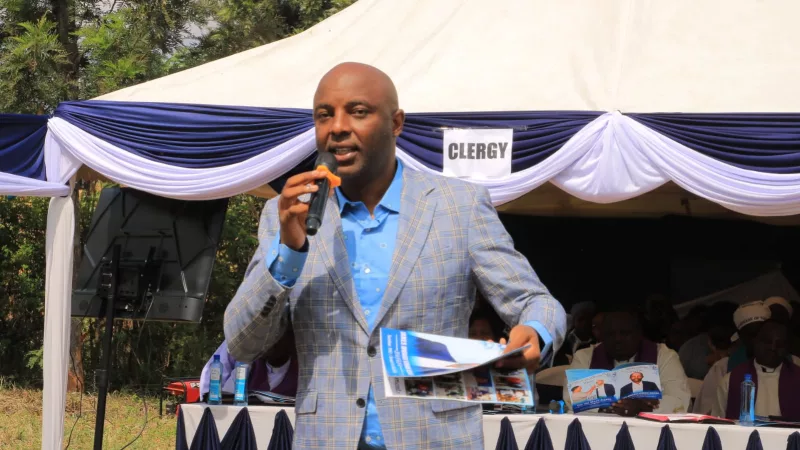
Mandera South MP Abdul Haro wants teachers compensated in, among others house, commuter, hardship and special duty allowances.
In a bill before the National Assembly, the MP also wants teachers with administrative responsibilities paid responsibility allowances.
“The commission shall pay house allowance to every teacher in its employment at a rate determined by the commission from time to time,” the proposed law reads.
“Where a teacher is on interdiction and is on half salary, the commission shall pay the full house allowance until the case is determined.”
A teacher under interdiction or suspension would, however, not be entitled to payment of commuter allowance.
The proposed law further sets special school allowance for teachers “skilled in special education” and assigned to a special school.
A teacher who is blind, deaf, dumb, or with physical disabilities – certified by the disability council, will be paid aid allowances should the proposal sail through.
Haro is proposing a leave allowance to the teaching fraternity as well as a transfer allowance for teachers moved by the Teachers Service Commission from one county to another.
“The principal object of this Bill is to amend the Teachers Service Commission Act, 2012, in order to provide for various allowances that the commission may pay to teachers over and above their basic pay,” the lawmaker said.
The proposed law seeks to provide that the TSC may appoint a teacher in an acting capacity for at least 30 days, and not more than six months.
“A teacher shall not be appointed in an acting capacity unless the person satisfies all the prescribed qualifications. A teacher shall only [be] in one position at a time,” the bill reads.
“A teacher appointed in an acting capacity shall be entitled to a special duty allowance.
“The bill therefore provides the predictability and certainty in the management of allowances in the teaching profession.”
Haro said the allowances would be non-pensionable.
On the hardship allowance, he suggests that it be paid to teachers assigned to a designated and gazetted hardship area.
Parts of Baringo, Garissa, Homa Bay, Isiolo, Kajiado, Kwale, Mandera, Kitui, Narok, Samburu, Taita Taveta, Tana River, Turkana, Wajir and West Pokot counties are gazetted hardship areas.
Select teachers who work in the areas earn between Sh6,500 and Sh36,000 monthly in extra perks, to beat the tough working conditions - lack of water, electricity and, in many cases, insecurity.
The proposed law seeks to hand special duty allowances to teachers appointed to perform administrative duties above the teacher’s pay grade.
Haro wants the perks – special duty allowance, extended to teachers who are stationed in arid and semi-arid lands.
“A teacher shall relinquish the allowance where the teacher is transferred out of the ASAL areas, relieved of administrative duties, or attains the grade for the post in which the teacher was acting,” the proposed law reads.
Heads of institutions and their deputies, as well senior teachers who in Job Group K and below, would be entitled to a responsibility allowance, as per the proposed legislation.
It adds that “the commission shall stop payment of responsibility allowance to a teacher where the teacher ceases to perform administrative responsibilities.”
Further on the transfers, the bill says that the TSC will not pay the allowance to a teacher who initiates a transfer.
Teachers are hard-pressed for extra incomes in the face of a proposed tough legal regime that seeks to ban any extra jobs by teachers.
Already, the government has imposed a tuition ban, including weekend and evening remedials.
The government, in a proposed law by the teachers employer TSC, seeks to make it expressly illegal for teachers to undertake or facilitate holiday tuition.
The Nancy Macharia-led commission also wants teachers barred from “engaging in other gainful employment while they are employees of the commission.”
The government banned holiday tuition in 2008, restated the same in 2016 but there have been numerous instances of violation by many schools.
The TSC also seeks to punish teachers for “fraudulent activities that contravene the provisions of the law.”
It will be a punishable offence for teachers to violate guidelines and directions issued or disseminated by the commission.
Kenya National Union of Teachers termed the proposals as arbitrary, and demanded thorough public participation.
Recently, the union lamented the hiring of teachers on acting capacity for more than six months without pay.
Collins Oyuu, general secretary of KNUT, wants any teacher assigned a duty to act either as a head teacher or deputy in another school or his station, be paid acting allowance.
The union’s boss took issue with the TSC for re-assigning teachers duties in schools to act as heads or deputies, without compensating for their time in service.