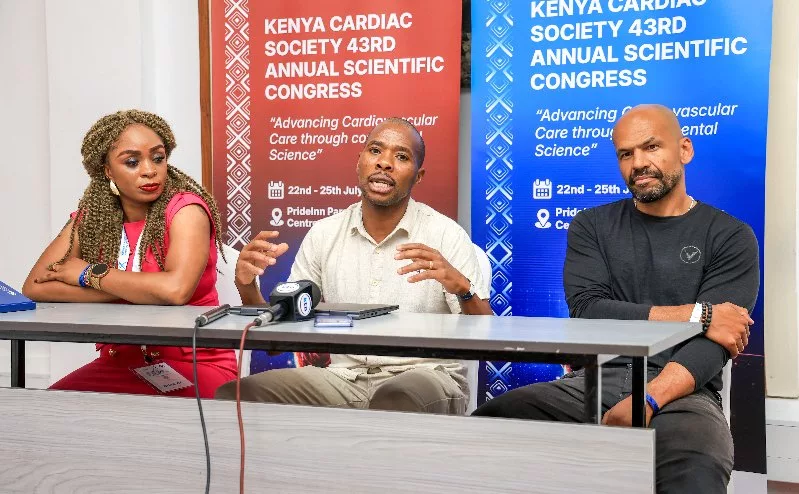
 Yvette Kisaka, Mzee Ngunga and Anders Barasa in Mombasa on Wednesday
Kenya is increasingly attracting patients from across the world who are seeking specialised medical care, particularly for cardiovascular diseases.
This is because investments in healthcare infrastructure and specialist training have boosted the
country's reputation as a regional medical hub.
Technical Lead for Sickle Cell and Cardiovascular Diseases at the Health ministry Yvette Kisaka said patients are travelling to Kenya from countries including the United Kingdom because treatment is more accessible, less bureaucratic and comparatively affordable.
"You will be surprised that people are coming from all over the world to get specialised services, especially for cardiovascular care," Kisaka said.
She spoke on the sidelines of the 43rd Kenya Cardiac Society Annual Scientific Congress in Mombasa on Wednesday.
She attributed the growing confidence in Kenya's health sector to investments in specialist doctors, modern medical equipment and improved healthcare facilities.
"We have a lot of UK citizens coming to Kenya for specialised care because they find it less hectic and cheaper here than in their own country," she said.
Kenya Cardiac Society president Dr Mzee Ngunga said the country's cardiovascular care capacity has expanded significantly over the past decade, driven by increased investment in training institutions, specialists and medical technology.
He said Kenya now has more catheterisation laboratories (cath labs) than all other countries in Eastern Africa combined, strengthening its position as a regional referral hub for heart care.
The society, whose membership has grown to more than 300 specialists and associates, has also digitised its cardiovascular disease guidelines, allowing doctors across the country to access clinical guidance through their mobile phones.
The digital platform is integrated with an artificial intelligence application developed in Africa to help monitor how the guidelines are used and improve patient management.
Despite these advances, Ngunga warned that cardiovascular diseases remain one of Kenya's biggest health challenges.
Heart failure, he said, is becoming increasingly common among adults, largely because of rising cases of high blood pressure, diabetes and obesity.
"Every fourth or fifth adult may have high blood pressure, and many do not even know it," he said, urging Kenyans to undergo regular health checks to detect the condition early.
He said diabetes now affects nearly eight per cent of the adult population, further increasing the risk of heart disease.
Children are also affected, mainly through congenital heart defects that develop before birth.
Ngunga said unhealthy lifestyles, including smoking, excessive alcohol consumption and poor diets, continue to fuel cardiovascular diseases and stroke, which are also linked to uncontrolled hypertension and diabetes.
He acknowledged that while the country has expanded the number of specialists and cardiovascular equipment, including in county hospitals, access to treatment remains uneven.
"The biggest challenge in Kenya is the affordability of cardiovascular services for Kenyans," he said, noting the irony that some foreign patients can access specialised treatment more easily than many local citizens.
Consultant cardiologist and heart failure specialist Dr Anders Barasa said another major challenge is the lack of reliable local data on cardiovascular diseases.
He said Kenya's cardiovascular treatment guidelines are still largely based on research from countries such as the United States and Canada because of limited local evidence.
"We need more information from our own population. That is why we have started disease registries to better understand how many people are affected and the different forms these diseases take," Barasa said.
He said better local data will enable the country to develop more accurate treatment guidelines and improve planning for cardiovascular care.
Barasa welcomed the growing role of artificial intelligence in medicine but cautioned that it should not overshadow more urgent challenges, particularly the affordability and accessibility of treatment.
"Within the next decade, AI will likely become part of every physician's daily work, but it still has significant limitations and is not yet fully reliable," he said.
Kisaka said cardiovascular diseases remain a major public health concern as Kenya advances towards Universal Health Coverage.
She said cardiovascular conditions account for about 13 per cent of deaths in the country and between 25 and 50 per cent of hospital admissions.
As the government continues investing in healthcare infrastructure and specialist services, she said improving access and affordability for Kenyans remain central to the country's health reforms.
Instant analysis
Kenya's emergence as a destination for specialised cardiovascular care signals growing confidence in its health system and reflects years of investment in specialist training and medical infrastructure. However, the country's medical tourism ambitions expose a stark paradox: while foreign patients are drawn by affordable, quality care, many Kenyans remain priced out of the same services. At the same time, cardiovascular diseases are rising rapidly, fuelled by hypertension, diabetes and lifestyle-related risk factors. Sustaining Kenya's competitive edge will require balancing investment in advanced technologies with reforms that improve affordability, expand insurance coverage, strengthen prevention and generate local research to guide policy and treatment.