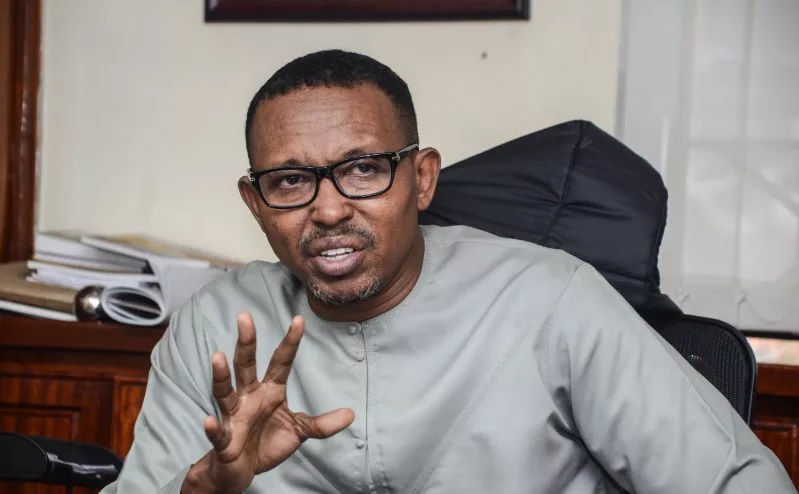
 Nyali MP Mohamed at his office during an interview on June 24, 2026./DOUGLAS OKIDDY
Nyali MP Mohamed Ali has opened up on his bid for the Mombasa
governor’s seat, declaring that he is driven by a desire to fix what he
describes as years of poor leadership.
Ali, popularly known as Jicho Pevu, said he wants to lead
the coastal county because he believes Mombasa can perform much better in
healthcare, education, sanitation, and service delivery.
The second-term lawmaker insists that he is not intimidated
by wealthy political rivals despite lacking deep pockets himself.
"I want to be governor because I believe Mombasa
deserves better," Ali said during an explosive interview with the Star in
his office in Parliament Buildings.
"Our people are struggling with poor healthcare,
unemployment, poor sanitation, and inadequate public services. These are
problems that require leadership, commitment, and honesty."
Ali spoke as the race for the coast county’s top continues to
attract bigwigs in what pans out as a battle of titans.
At least six other aspirants are eyeing the seat in next
year’s general election.
They include incumbent Governor Abdulswamad Shariff Nassir,
EALA MP Suleiman Shahbal, UDA Secretary-General Hassan Omar, former Nyali MP
Awiti Bolo, former Kisauni MP Ali Mbogo and County Assembly Speaker Aharub
Khatri.
The outspoken legislator said his experience ‘transforming’
Nyali Constituency had convinced him that he could replicate the same success
across the county.
"When I became MP, Nyali had only one public secondary
school. Today, we have built many schools, improved roads, installed street
lights, strengthened security, and invested heavily in education. That is the
kind of development I want every part of Mombasa to enjoy."
Ali said education remains the foundation of his development
agenda.
"I joined politics because I wanted to empower people
through education. If you educate a child, you change an entire family. That
has always been my philosophy."
"You can have a beautiful house where one room is
spotless while the rest are in terrible condition. My goal is to ensure every
ward benefits equally."
Ali singled out healthcare as one of the biggest challenges
facing the county.
"Our hospitals are struggling. Patients should not be
forced to buy basic drugs or seek treatment elsewhere. We must restore dignity
in public healthcare."
He noted that Mombasa serves as the main referral centre for
the Coast region and therefore requires substantial investment.
"Mombasa receives patients from neighbouring counties
every day. We cannot continue operating facilities that are overwhelmed while
expecting quality healthcare."
Ali also promised to revive the county's economy by
strengthening tourism, improving cleanliness and creating a business-friendly
environment.
"Mombasa is Kenya's tourism capital. If we improve
security, cleanliness and infrastructure, investors will come, businesses will
thrive and young people will get jobs."
Ali said he is undeterred or shaken by bigwigs he is facing
in the race for the seat.
"I know many of those seeking this seat have enormous
financial resources. I don't have that kind of money, but I am not
scared."
He argued that elections are ultimately decided by voters
rather than campaign spending.
"If money decided elections, many leaders in this
country would never have lost. Leadership is not about who spends the most
money. It is about who earns the trust of the people."
Ali said he intends to run a grassroots campaign focused on
his record rather than financial muscle.
"My biggest asset is the people of Mombasa. They know
what I have done in Nyali and they know the kind of leader I am."
He cited his stewardship of the Parliamentary Service
Commission's Finance Committee as evidence that he possesses the managerial
skills required to run the county government.
"I oversee a budget of more than Sh46 billion every
year in Parliament. Mombasa's budget is much smaller. Managing public resources
responsibly is something I already do."
Ali also criticised leaders whom he accused of relying on
political personalities instead of delivering tangible development.
"People should not vote based on political slogans or
personalities. They should ask what each candidate has done and what they
intend to do for Mombasa."
Political analysts expect next year's gubernatorial contest
to be among the most competitive in the country, with incumbency, party
influence, financial resources and individual track records all expected to
shape the outcome.
For Ali, however, the campaign will revolve around a simple
message.
"This election is about changing Mombasa," he
said.
"I want to build a county where hospitals work,
children get quality education, businesses grow, neighbourhoods are clean and
every resident feels the impact of good leadership. That is why I am seeking
the governorship."
INSTANT ANALYSIS
Mohamed Ali's entry adds a fresh dynamic to the Mombasa governor's race by positioning himself as an outsider challenging both the political establishment and wealthy rivals. His campaign seeks to leverage his development record in Nyali and anti-corruption credentials rather than financial muscle. However, translating constituency-level popularity into countywide support will be a tougher task. With incumbent Abdulswamad Shariff Nassir and other influential contenders in the race, Ali will need broad political alliances and a strong grassroots network to overcome the advantages of better-funded competitors.