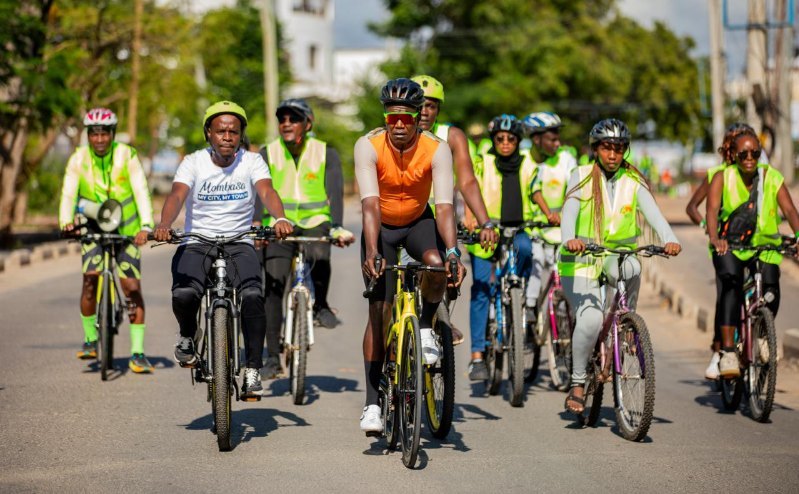
On a typical weekday morning in Mombasa, traffic begins building up along major roads leading to the town centre.
Vehicles clog key corridors, commuters spend more time on the road, and the city's limited space is stretched further by a growing population and rising vehicle ownership.
For decades, the answer to congestion has often been wider roads and additional lanes. However, Mombasa is now pursuing a different solution: bicycles.
From Links Road in Nyali to the town centre, and from Makupa Bridge to the town centre, the Mombasa County Government is investing in dedicated cycling infrastructure as part of a broader vision to transform the island city into one of Africa's most bicycle-friendly urban centres.
The shift is not simply about creating lanes for cyclists. It is about reimagining how people move in one of Kenya's most densely populated and rapidly urbanising counties.
Deputy Governor Francis Thoya, an avid cyclist, believes the city has little choice but to rethink its transport future.
"Mombasa has one major challenge, and that challenge is space. As the country's smallest county geographically, Mombasa faces mounting pressure from population growth and vehicle ownership," he said.
He added; "The time has come for us to start thinking about whether we need to continue using our vehicles to go to work or use other means of transport."
He said cycling is increasingly becoming a practical option in cities facing severe congestion.
Unlike many Kenyan towns, Mombasa's relatively flat terrain, short commuting distances and warm climate make it naturally suitable for cycling.
However, for years, cyclists have been forced to share roads with speeding vehicles, exposing them to significant risks.
A traffic survey conducted by the County department of transport and infrastructure revealed that 88.5 per cent of cyclists along Links Road ride directly on the roadway because there is no dedicated cycling infrastructure.
The study also found that many pedestrians would consider cycling if safer facilities existed.
The findings helped shape the county's application to the Bloomberg Initiative for Cycling Infrastructure (BICI), a global programme supporting safer urban mobility.
In 2022, Mombasa became one of the only 10 cities worldwide selected for the initiative, securing technical and financial support to expand its cycling network from nine kilometres to 16.6 kilometres of fully protected tracks.
The city was selected from a competitive pool of 275 applicants globally, joining cities such as Bogotá, Milan, Lisbon and Addis Ababa.
The first phase focuses on a 9.3-kilometre corridor covering Links Road, Fidel Odinga Road, Nyali Bridge and Makupa Bridge.
According to Transport and Infrastructure executive Daniel Manyala, the project is designed to protect vulnerable road users who currently compete for space with vehicles.
"This corridor sees up to 800 cyclists and 50,000 pedestrians during peak hours. The lanes are intended to protect them and reduce conflicts with motor traffic," he said.
The infrastructure goes beyond simply painting bicycle symbols on the road.
The design includes protected cycle tracks, pedestrian walkways, safety buffers, greenery, safer crossings and measures to separate cyclists and pedestrians from fast-moving traffic.
Along Nyali and Makupa bridges, two of the busiest connections between Mombasa Island and the mainland, lane separators will be introduced to prevent vehicle encroachment and improve cyclist safety.
These bridges collectively serve hundreds of thousands of users daily and already accommodate significant numbers of cyclists.
Supporters argue that the bicycle lanes are about much more than mobility. They are also a climate action measure.
As vehicle numbers increase, so do fuel consumption, emissions and the economic costs associated with traffic congestion.
According to Thoya, cycling presents an opportunity for residents to reduce transport costs while helping the city cut carbon emissions.
"Going green is to start using things like bicycles," he said, adding that congestion ultimately carries a financial burden for both individuals and government through wasted fuel and lost productivity.
For businesses, cycling infrastructure can also stimulate local economies.
Claire Birungi, Director for Institute for Transportation and Development Policy Africa, said safe cycling networks encourage more people to move around neighbourhoods and access businesses.
"If we make the infrastructure safe, we will see more businesses attracting more customers and growing because people can hop in and out and engage in economic activity more easily," she said.
Perhaps the biggest challenge is not engineering but culture. For many years, urban transport planning in Africa has largely prioritised cars.
Birungi argued that cities must start designing roads around people rather than vehicles.
"We have not been designing necessarily for people and how people actually want to move," she said, calling on transport planners and engineers to embrace sustainable mobility principles that prioritise walking, cycling and public transport.
Evidence suggests the demand already exists.
County surveys found that many cyclists use bicycles several times a week despite inadequate infrastructure. Many non-cyclists also indicated they would consider taking up cycling if safety improved.
The goal, advocates said, is not to force people out of their cars but to give them realistic alternatives.
For global partners supporting the project, Mombasa represents an opportunity to demonstrate how African cities can build safer and more sustainable transport systems.
Regatu Solomon of the Global Designing Cities Initiative said the programme aims to ensure safe infrastructure for cyclists and all road users while helping cities create healthier urban environments.
Meanwhile, cycling advocates are already seeing signs of change.
E-bee Africa managing director Marten Fonteija believes the completion of the first phase marks the beginning of a new chapter for the city.
"Mombasa is really gearing up to start using bicycle lanes to avoid spending a lot of time in traffic and to create a healthier Mombasa," he said.
However, the county will need to expand infrastructure beyond a few corridors, integrate cycling with public transport, improve safety education and encourage more women and children to embrace cycling.
INSTANT ANALYSIS
Mombasa's investment in cycling infrastructure reflects a strategic response to rapid urbanisation, growing traffic congestion and climate concerns. As Kenya's smallest county by land size, the city has limited room for road expansion, making alternative transport solutions increasingly necessary. The bicycle lane project is backed by data showing significant pedestrian and cyclist activity despite inadequate infrastructure, highlighting latent demand for safer mobility options.
![[PHOTOS] Raila Odinga Stadium construction enters home stretch](https://cdn.radioafrica.digital/image/2026/06/45f6990c-4882-4cd2-b83c-8fc730dcdce5.jpg)