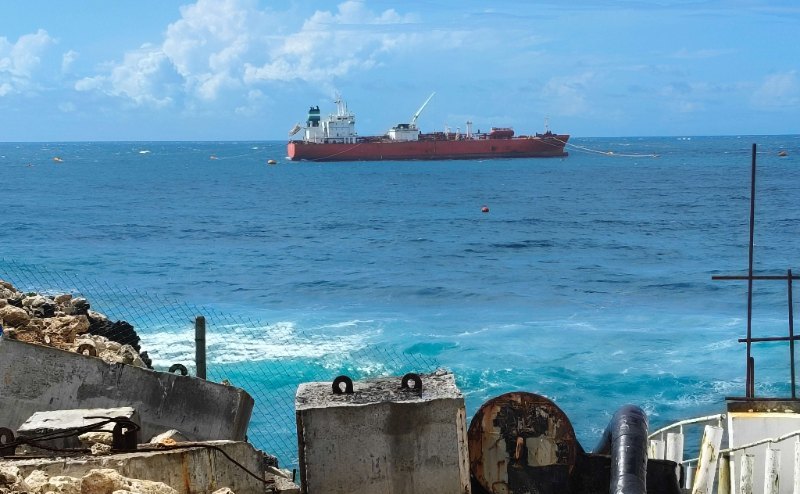
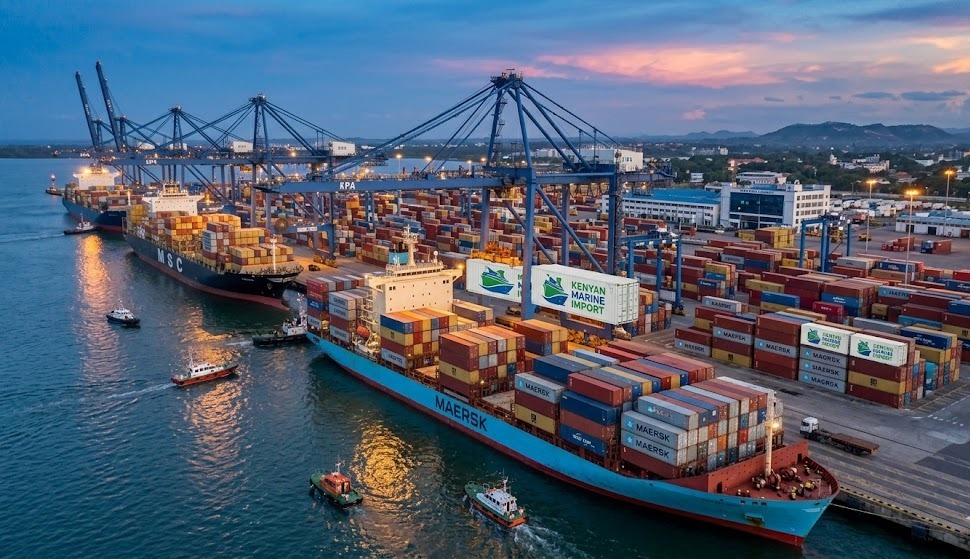
 An oil vessel in the Indian Ocean in Kilifi county / BRIAN OTIENO
An environmental advocacy organisation has expressed concern over the Kenyan government's plan to roll out new offshore oil and gas licences.
Earth Insight, in a report released on June 4, said the new licensing round would directly affect coastal coral reefs, mangroves, marine and coastal protected areas, and key biodiversity areas.
"Kenya's planned licensing round puts ecosystems, fisheries and coastal communities at risk," the report, dubbed Fossil Fuel Threats to the Ocean: Marine Life and Coastal Communities at Risk, states.
Earth Insight, in collaboration with civil society organisations from around the world, including the Kenya Oil and Gas Working Group (KOGWG), said geospatial analysis across 11 case studies indicates that some of the world's most ecologically critical and legally protected marine regions are under threat from oil and gas exploration.
The 11 case studies, spanning Kenya, Tanzania, Cameroon, Norway, Alaska, Jamaica, Trinidad and Tobago, Argentina, Mexico, Indonesia and Australia, are experiencing a new wave of offshore oil, gas and LNG expansion.
The Kenyan government has revived and is rolling out a new offshore oil and gas licensing round, offering 10 premium exploration blocks in the Lamu and Anza basins.
The Anza Basin is an 81,000-square-kilometre multi-phase continental rift basin in North Eastern and Coastal Kenya.
It is part of the Central African Rift System. It stretches north-west from the Lamu Embayment to the South Sudan border and features significant oil and natural gas exploration potential.
Kenya has selected 10 highly prospective blocks based on extensive geoscientific data.
To attract global capital, the country has restructured its 50 existing exploration blocks, offering flexible Production Sharing Contracts (PSCs) and competitive tax packages.
KOGWG's Muturi wa Kamau said it is ironic that Kenya is preparing to open ecologically sensitive offshore areas for fossil fuel exploration at the very moment it is hosting a global conference on ocean protection.
Kenya is set to host the Our Ocean Conference, the premier global forum on ocean protection, in Mombasa from June 16 to 18.
"Meanwhile, Kenya's government is preparing to open up to 50 new oil and gas blocks to investors — up to 10 in the second half of 2026, with eight in the ecologically sensitive Lamu Basin. The question is: at what cost are we willing to risk these fragile ecosystems and the livelihoods of coastal communities who have depended on them for generations?" Kamau posed.
According to Kamau and the Earth Insight report, Kenya's proposed blocks cover the entirety of the country's key coastal marine habitats.
The report's geospatial analysis of the Lamu Basin and surrounding waters found that 100 per cent of coral reefs (410km²), mangroves (540km²), marine and coastal protected areas (2,480km²) and key biodiversity areas (2,410km²) are directly overlapped by proposed oil and gas blocks.
The analysis also found that virtually all ecologically or biologically significant marine areas (14,190km²) and 61 per cent of important marine mammal areas (42,200km²) fall within the proposed blocks.
"This means Kenya's most fragile and biologically productive marine ecosystems would be directly exposed to the risks of seismic surveys, offshore drilling, oil spills and underwater noise pollution," Kamau said.
The Lamu Basin is one of East Africa's most important biodiversity hotspots. Its waters are home to coral reefs, seagrass meadows, mangrove forests, five sea turtle species and the vulnerable dugong.
These ecosystems sustain artisanal fisheries and the long-established Swahili communities whose livelihoods, cultural identity and daily practices are closely tied to the sea, Kamau said.
"For thousands of fisherfolk and marine-dependent households, their degradation would mean the loss of food security, income and cultural survival," he said.
The Earth Insight report urges governments, financial institutions and international bodies to stop granting new licences, permits and approvals for offshore and coastal oil, gas and LNG projects in or near protected areas, key biodiversity areas, IMMAs, EBSAs, coral reefs, mangroves and seagrass meadows.
The report also calls on governments to establish legally binding fossil-free zones in areas of high ecological, cultural and community importance.
"They should align ocean protection with the 30x30 commitment to protect 30 per cent of marine areas by 2030, backed by real restrictions on fossil fuel activity," the report states.
KOGWG said there is a need to seek the prior and informed consent of indigenous people and affected communities before any licensing is undertaken.
The working group also called for an end to public and private financing of new offshore oil, gas and LNG expansion.
"It is alarming to see the research findings and the sheer scale of fossil fuel expansion trajectories threatening the health and future of our shared ocean," said Tyson Miller, Earth Insight executive director.
Miller said country commitments to protect 30 per cent of the ocean by 2030 represent a unique opportunity to restrict fossil fuel blocks and concessions in order to uphold the integrity of existing and future marine protected areas, whale and marine mammal corridors, and the health of coral reefs, seagrasses and mangroves, as well as the communities that depend on them.








![[PHOTOS] The Star, Chinese Embassy host Kenya-China media dialogue](https://cdn.radioafrica.digital/image/2026/06/215e29cd-5ca2-4faf-bb4e-d1686b2c3dad.jfif)