 Mombasa County Blue Economy Executive Ibrahim “Babangida” Khamis,
former TSC director Mohammed Mwinyipembe, and Mombasa Senator Mohamed Faki at
the Bomu Stadium on Sunday /BRIAN OTIENO
Mombasa County Blue Economy Executive Ibrahim “Babangida” Khamis,
former TSC director Mohammed Mwinyipembe, and Mombasa Senator Mohamed Faki at
the Bomu Stadium on Sunday /BRIAN OTIENO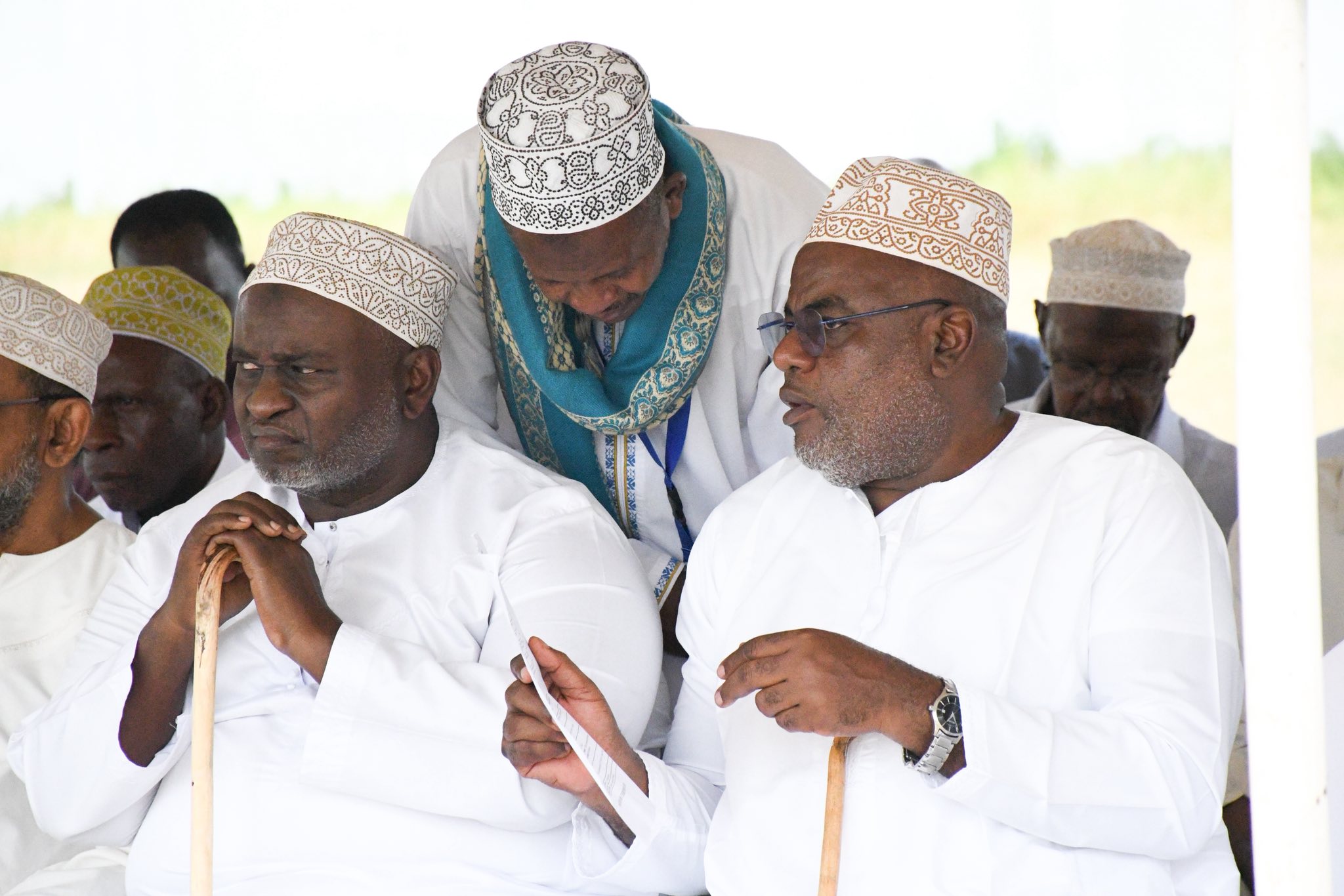 Mombasa County Blue Economy Executive Ibrahim “Babangida” Khamis, Wachangamwe Community Welfare
chairman Athman Mohamed and Mombasa Senator Mohamed Faki at Bomu Stadium on
Wednesday /BRIAN OTIENO
Mombasa County Blue Economy Executive Ibrahim “Babangida” Khamis, Wachangamwe Community Welfare
chairman Athman Mohamed and Mombasa Senator Mohamed Faki at Bomu Stadium on
Wednesday /BRIAN OTIENOJob opportunities remain scarce for young people from the Wachangamwe community due to low levels of education, community elders have said.
The elders on Wednesday expressed concern that many learners drop out after Class 8 or Form 4, significantly limiting their chances of securing formal employment.
Wachangamwe Community Welfare chairman Athman Mohamed said the situation has left many youths without the skills needed to compete in the job market, prompting a new campaign to encourage enrolment in tertiary institutions.
“In education, we are very poor. Our children think they have reached the pinnacle when they complete Class 8 or Form 4, and they stop there,” he said.
Mohamed said the community risks missing out on numerous opportunities if young people fail to pursue further training or skills development.
Mombasa Senator Mohamed Faki, who hails from the community, said a lack of education and unemployment have contributed to rising cases of drug abuse and crime among frustrated youth.
“We came together as a community to discuss these issues and chart a way forward,” he said.
He said access to government opportunities requires adequate skills and qualifications, which many youths currently lack.
Mombasa county blue economy executive Ibrahim “Babangida” Khamis said the community is lagging behind in education at all levels, including secular, religious and technical training.
He revealed the transition rate from primary to secondary school stands at about 10 per cent among Wachangamwe learners, compared to the county average of 20 per cent.
“That is why we must sensitise our people that failing to join university is not the end. There are opportunities in TVETs and VTCs where young people can gain technical skills,” Khamis said.
He cautioned against pursuing opportunities such as STCW (Standards of Training, Certification and Watchkeeping for Seafarers) without relevant foundational skills.
“STCW alone is not a profession. You must first have a trade, such as electrical or catering skills, so that the certification can be useful at sea,” Khamis said.
Scholar Mohamed Mwinyipembe, who is pursuing a PhD, said the community must take responsibility instead of blaming marginalisation alone.
Citing a proverb, he said, “Tie your sheep well and then ask God to protect it. If you do not prepare, you cannot blame others for the outcome.”
He challenged the community to demonstrate competitiveness by producing qualified graduates who can access available opportunities.
Mwinyipembe also faulted parents for misplaced priorities, saying more emphasis is placed on social events than on education.
“It is easier to raise money for weddings than to support a child joining university. We must rethink our priorities,” he said.
He said education has no limit, noting that he is currently pursuing his third degree.
Instant analysis
The Wachangamwe community’s unemployment challenge reflects a deeper structural problem rooted in low educational attainment and weak transition rates beyond primary and secondary schooling. Elders and leaders highlight that many youths exit the education system early, limiting access to formal jobs and pushing some into drugs and crime. The discussion also exposes a skills mismatch, where young people pursue certificates such as STCW without foundational technical training. While opportunities exist in TVETs and the blue economy, uptake remains low due to awareness and attitude gaps. Overall, the issue underscores the need for stronger parental engagement, prioritisation of education and targeted skills development to improve employability outcomes.