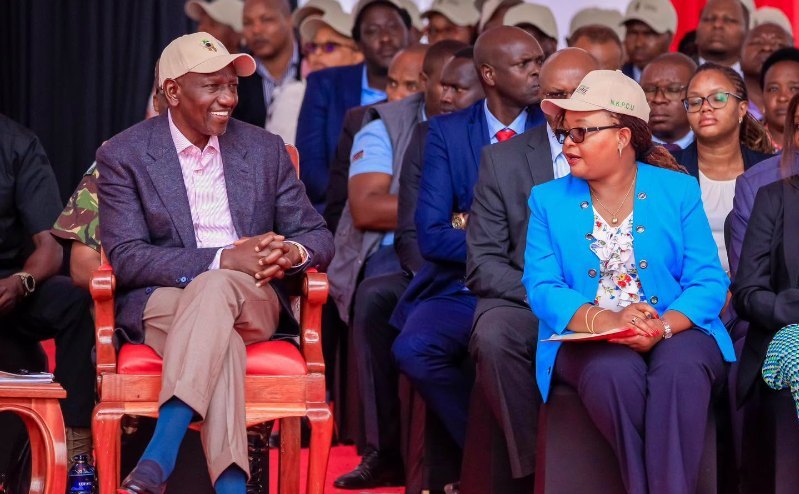
 President William Ruto and Kirinyaga Governor Anne Waiguru during the launch of the National Coffee Revival Through Cooperative Societies Programme at Kassam Stadium on June 22, 2026 /ALICE WAITHERA
Mt Kenya leaders on Monday offered strong political backing to President William Ruto’s coffee sector reforms.
They framed the ongoing
interventions as a turning point in a value chain long weighed down by
inefficiencies, delayed payments and entrenched middlemen.
The leaders said the reforms were already restoring confidence among farmers and improving earnings across key producing counties.
They spoke during the launch of the National Coffee Revival Through Cooperative Societies Programme at Kianyaga Stadium in Kirinyaga County.
At the centre of the government’s push is a new Direct Settlement System, under which farmers will be paid within five days of delivering their coffee.
Ruto said the model is designed to eliminate the long-standing payment delays that in some cases stretched into months or entire seasons.
“Farmers will no longer be waiting for weeks, months or entire seasons to be paid. Timely payment is not a favour to the farmer; it is the farmer’s right,” he said.
Beyond payment reforms, the President said the restructuring of the sector is aimed at removing inefficiencies and ensuring a larger share of export earnings reaches farmers directly rather than being absorbed by intermediaries.
Under the new framework, farmers will receive at least 80 per cent of proceeds from coffee sales, with service providers sharing the remaining 20 per cent.
The reforms are also tied to a broader agricultural strategy that includes improving productivity and reducing production costs.
Ruto pointed to Sh18 billion allocated to the fertiliser subsidy programme, which has reduced fertiliser prices from Sh7,500 to Sh2,500 per bag.
A further Sh2 billion has been set aside to clear coffee sector debts, while another Sh2 billion is directed towards factory upgrades and the distribution of high-quality seedlings.
He challenged Kenyans to increase local consumption of coffee, arguing that a stronger domestic market would complement exports and cushion farmers against global price fluctuations.
Cooperatives CS Wycliffe Oparanya said the reforms had been institutionalised through the re-establishment of the Coffee Board, reversing its earlier merger into the Agriculture and Food Authority.
He said the focus of government policy had shifted from production alone to profitability for farmers.
“The most important thing is to make sure the Kenyan farmer gets money in their pocket. Coffee farming is only meaningful if the farmer earns from it,” Oparanya said.
He said the government is targeting a tripling of annual coffee production from about 50,000 tonnes to 150,000 tonnes by 2028.
However, he said productivity remains a key challenge, with the average coffee tree producing only about two kilogrammes of cherry.
To address this, the government is promoting improved seedlings, better agronomic practices, extension services and stronger cooperative systems, with the aim of raising yields to at least six kilos per tree.
At the county level, leaders presented early evidence of what they described as a recovery in the sector.
Kirinyaga Governor Anne Waiguru said coffee production in her county had risen from 28,000 tonnes in 2017 to 49,100 tonnes in the 2025-26 season, generating Sh7.48 billion for farmers.
She said payouts had reached as high as Sh157 per kilogramme of cherry, with an average of about Sh140, attributing the gains to coordinated investments in seedlings, subsidised fertiliser, factory modernisation and farmer training.
“Our county is home to 120,000 coffee farmers and this sector remains one of the most important economic pillars supporting thousands of families,” the county chief said.
Waiguru also highlighted the role of the Kirinyaga Slopes Coffee Brokerage Company, which has sold more than 18,000 tonnes of clean coffee between 2023 and 2026, earning farmers Sh14.6 billion.
Embu Governor Cecily Mbarire credited the reforms with dismantling long-standing cartel networks in the coffee value chain, saying earlier attempts at reform had failed due to resistance within the system.
Her county has invested more than Sh150 million in upgrading coffee factories and improving marketing through the Nairobi Coffee Exchange.
Laikipia Governor Joshua Irungu said the reforms had also encouraged coffee farming in traditionally arid and semi-arid areas, with more than one million seedlings distributed in the past three years.
He expressed optimism the crop could eventually generate more than Sh10 billion annually for residents.
Despite the optimism from political leaders, farmers used the platform to push for deeper structural changes.
Among their proposals was an increase in advances under the Cherry Advance Revolving Fund from Sh40 to Sh60 per kilogramme, arguing that access to credit remains critical during production cycles.
“We want our coffee processed and packaged in Kenya instead of exporting it as raw material. That is how farmers will earn more from their produce,” said Shabby Asha, a farmer representative from Bungoma.
While government and county leaders presented a narrative of recovery and revival, the broader challenge remains whether the reforms can sustainably dismantle entrenched value chain interests and translate political momentum into long-term farmer empowerment.
Instant analysis
The coffee sector reforms highlighted at Kianyaga reflect a broader government attempt to reposition agriculture as a driver of rural incomes and export earnings. While leaders from Mt Kenya counties point to improved prices, faster payments and rising production as signs of progress, the sustainability of these gains will depend on whether structural inefficiencies and historical cartel networks are fully dismantled. The Direct Settlement System and subsidy programmes may improve liquidity for farmers, but long-term success hinges on productivity growth and value addition. The emerging tension is between political optimism and the practical realities of implementation at cooperative level.
![[PHOTOS] Raila Odinga Stadium construction enters home stretch](https://cdn.radioafrica.digital/image/2026/06/45f6990c-4882-4cd2-b83c-8fc730dcdce5.jpg)