In Kandara subcounty, Murang’a county, Milkah Wairimu is sitting under a tent packed with chairs outside a building marked therapy centre.
Wairimu, 48, had just arrived at the centre minutes earlier and was waiting for two patients ahead of her to be served.
She had travelled from Githurai 45, Kiambu county, for bee venom therapy for her arthritic feet at the Bella Apitherapy centre.
Wairimu started experiencing pain in her back years ago when her daughter, now in high school, was in lower primary level.
Though excruciating, the pain would come and go, allowing her to continue with her daily activities.
Her concern, however, started when the pain started moving downwards to her feet and settled at the back of her knees, and became frequent.
“That’s when I visited a hospital and after numerous tests, I was diagnosed with arthritis. I was given medicine but the pain was always there and worsened during cold seasons,” she said.
Her condition was aggravated by her occupation as a market trader as she has to work late hours and wake up before dawn.
She invested in leg warmers and warm clothes but the pain persisted, making her dependent on pain killers.
Early this year, however, her feet started swelling, slowing her down and worsening the pain. Doctors had to extract built up fluid, she said.
Two weeks ago, as she sat at her stall in pain, other traders noticed her prolonged silence and sought to establish what was bothering her.
“I told them I was in too much pain and that I suffered from arthritis, which had made my walk slow. One told me she had earlier suffered from the condition and managed it using bee venom, and referred me to this centre,” Wairimu said.
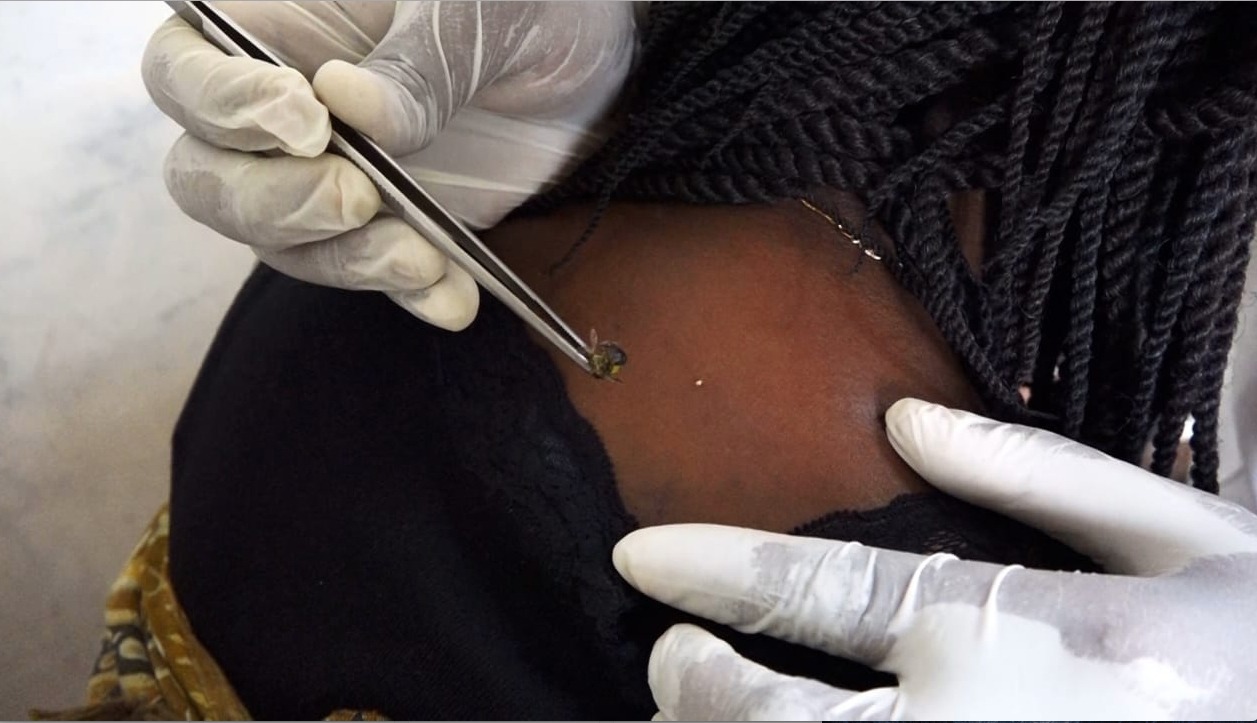
“I came here for the first time last week, I had three bee stings on each knee and the swelling has gone down significantly. I have also not taken pain killers since,” she said, showing off her slightly swollen feet that she had covered in a long skirt.
It’s Wairimu’s turn to go in for the bee stings and she gets into the centre, coming out minutes later. The stings are painful, she said, but not as much as the arthritic pain she has endured for years.
Apitherapists at the centre recommended she visits twice a week but she was yet to get used to the itch that follows after the stings.
With the rising prevalence of chronic illnesses, more Kenyans are looking for alternative treatement.
Many have resorted to complementary and alternative medicine that involves medical practices that do not use conventional medicine, including use of natural products such as supplements and traditional treatments.
According to the National Institutes of Health, a US government agency that funds and conducts biomedical research, about 90 per cent of Kenyans have used traditional medicine at some point, with more than 70 per cent relying on homemade remedies as their first source of medicine.
Apitherapist Steven Kimani explained that bee venom is one of the numerous bee products and has been proven to manage several conditions.
Bee venom therapy has ancient roots and was used in Egypt in 2000 BC, ancient Greece in 460 BC and in traditional Chinese medicine more than 2,000 years ago to stimulate healing for joint pain and inflammation.
In the 19th century, researchers started studying bee venom more formally in Europe in 1930s.
Today, bee venom is used in complementary medicine for arthritis, chronic pain, autoimmune disorders, skin conditions and neurological diseases.
“When a client first gets here, we sting them once on the hand to test whether they are allergic to bee pollen. If they are, we put them on anti-histamines and discontinue the treatment,” Kimani said.
Trained as a civil engineer, Kimani said he worked for eight years before he ventured into beekeeping.
He was looking for a ‘side hustle’ in 2015 and had settled on dairy farming but realised he needed to be there physically. He also planted avocado trees. “One day, I found a bee pollinating an avocado tree and it sparked my interest in beekeeping but my initial thought was to sell honey,” Kimani said.
To deepen his knowledge, he undertook a certificate on beekeeping and got to know many bee products and their benefits and was surprised to learn that beekeepers rarely get sick.
“This told me there was something about bee venom from the stings or the bee products and fuelled my curiosity further,” Kimani said.
He then studied apitherapy in Romania and undertook an advanced beekeeping training with a Dutch company and set up an office in Nairobi before eventually relocating to Murang’a.
Kimani said the Kenya Agricultural and Livestock Research Organisation (KALRO) whose premises are nearby allowed him to set up an apiary on their farm, where he has kept 150 beehives that supply him with bee venom, wax, propolis, honey, pollen, bee bread, royal jelly, bee drone larvae and beehive air.
Kimani further explained honey is classified depending on the primary source of nectar such as eucalyptus, mangrove, acacia and forest honey that is made up of nectar from a mixed variety of trees.
The types of honey can then help manage various health conditions, he explained, with those made up of nectar from highlands helping to control respiratory conditions while those from lowlands helping clear skin conditions.
Bee wax on the other hand is used in making candles that are therapeutic and can also be applied back to the hives to attract new colonies.
Propolis is an anti-radiation product and is used as sunscreen in beauty products. It’s also good for tonsils, peptic ulcers, gastritis, toothache and infections.
Pollen is good for patients with chronic conditions and who require a lot of energy for their body to fight illnesses while bee bread is a predigested produce made up of bee pollen and saliva.
Royal jelly is used for conditions such as erectile dysfunction, while beehive air is good for respiratory conditions. Bee drone larvae is chewed to enhance sperm count.
When he started providing apitherapy, the reception was mixed, with some doubting it’s efficacy while those with chronic conditions were more willing to try it out.
“I have tended to clients with serious cases of arthritis who are more than willing to try the bee stings because the pain they is too much,” Kimani said.
“But some elderly people knew that bee venom was used by our ancestors to manage health conditions and we’re more open to it.”
Despite the mixed reaction, the centre has seen a steady rise of clients, with between 25 to 40 people streaming in daily.
Many have reported a positive improvement since starting the therapy, he said, proof apitherapy is complimentary medicine that can be used side by side with conventional medicine.
Further, Kimani said bee venom is instrumental in boosting immunity as it causes the body to produce antibodies that help fight diseases.
“The body has 13 acupuncture points that when stung by bee are able to heal specific body parts or organs”.
Kimani has made products such as facial and body creams, massage creams, herbal tea and cough syrups.
He also trains farmers on modern beekeeping and sells beehives to new farmers.
John Chomba, a 63-year-old therapy patient, told the Star he has been stung with bees more than 30 times.
A throat cancer survivor, Chomba said his stiff limbs have become flexible and the extreme pain eradicated.
“I could not move before. I had to be taken to the toilet and now I can do light duties and even go to the farm,” he said, proudly explaining that he recently pruned his bananas and lifted his arms to illustrate the good results.
He no longer feels pain as the bees sting him and looks forward to therapy sessions.