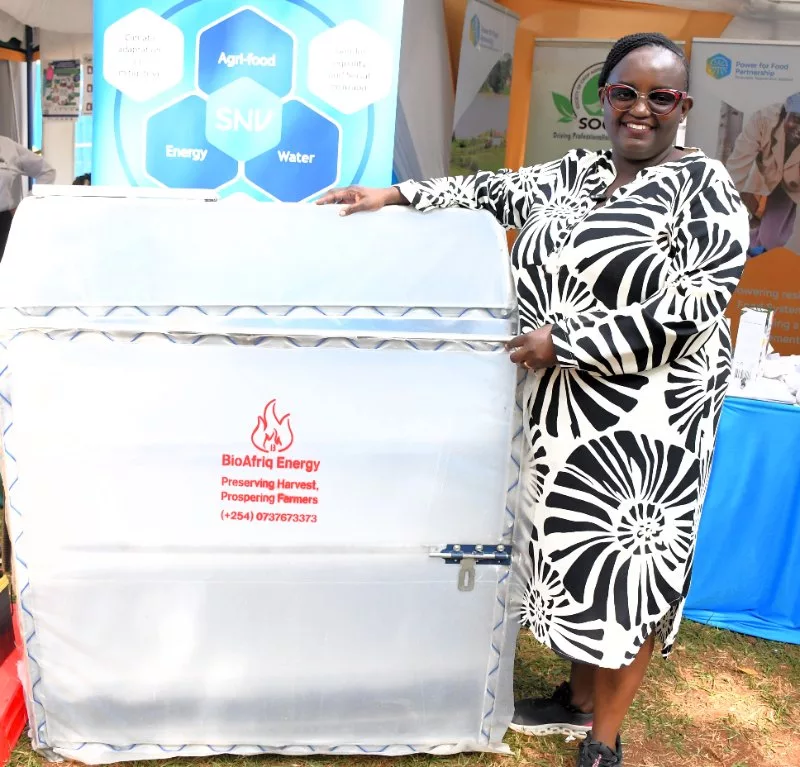
Doreen Achieng, co-founder BioAfriqu Energy Limited that has designed solar-powered hybrid food dehydrators./AGATHA NGOTHO.
A near loss of 50 tonnes of pumpkins inspired the
development of a solar food dryer that is now helping farmers cut post-harvest
losses.
Every harvest season, thousands of Kenyan farmers watch
their hard work go to waste. Mangoes rot beneath trees, pumpkins are left to
decay on farms and cassava spoils before reaching the market.
For many smallholder farmers, the biggest losses do not
occur in the field but after harvest.
Ministry of Agriculture and Livestock Development says Kenya
loses between 30 and 40 per cent of its agricultural produce after harvest,
depending on the crop and the level of value addition.
The losses cost farmers billions of shillings annually,
reduce food availability and undermine efforts to improve household incomes.
The Food and Agriculture Organization (FAO) estimates that
roughly 14 per cent of food produced globally is lost between harvest and
retail.
In Sub-Saharan Africa, inadequate storage, poor processing,
limited cold chains and weak market access remain the major drivers of
post-harvest losses.
In 2017, Doreen Achieng's family harvested 50 tonnes of
pumpkins under a farming contract in Machakos county.
However, when the buyer disappeared without collecting the
produce, months of investment in seeds, fertiliser, labour and irrigation were
on the verge of being wiped out.
Instead of accepting the loss, her mother decided to find a
solution.
Today, that experience has grown into BioAfrique Energy, a
Kenyan company designing solar-powered hybrid food dehydrators that enable
farmers preserve fresh produce, reduce post-harvest losses and earn more
through value addition.
Speaking during the Third National Agroecology Symposium,
Achieng, the company's co-founder, said the painful experience became the
turning point that inspired the innovation.
"Our project began in 2017 after a personal experience.
My mother had been contracted to grow pumpkins in bulk and harvested about 50
tonnes. When it was time for collection, the contractor disappeared,” she said.
“We were staring at a complete loss. We had invested in
seeds, fertiliser, irrigation and labour. We asked ourselves how we could
preserve the pumpkins instead of watching them rot."
Achieng said their first solution was a large 40-foot
container dryer. However, they soon realised such a system would be too
expensive for most farmers.
That prompted her co-founder, engineer James Nyamai, to
redesign the technology into smaller, affordable food dehydrators suitable for
individual farmers, co-operatives and small agro-processors.
The dehydrators use solar energy as the primary source of
heat and include an automated temperature monitoring system that allows farmers
to control drying conditions for different crops.
Unlike conventional solar dryers, the hybrid system also
incorporates a patented heat exchanger that uses farm waste as fuel during
cloudy weather or at night.
"What sets us apart is that our dryers are
temperature-automated. Farmers are able to monitor both temperature and
moisture levels throughout the drying process,” Achieng says.
“During cold weather or in the evening, they can use farm
waste to generate additional heat without exposing food directly to
smoke."
The technology can process a wide range of crops, including
cassava, sweet potatoes, pumpkins, bananas, mangoes, apples, plantains, herbs,
ginger, garlic, cereals and spices.
Once dried, the produce can either be packaged for storage
or processed into higher-value products such as flour.
BioAfrique works with its sister company, Taliana Foods, to
produce gluten-free flours from crops such as cassava.
Achieng noted that the biggest motivation for farmers is the
opportunity to earn more from the same harvest.
"Fresh cassava, for example, may fetch as little as
Sh10 per kilogramme at the farm gate during peak harvest. After drying and
processing, the same cassava can sell for between Sh40 and Sh90 per kilogramme,
depending on quality and the final product," she said, adding that value
addition completely changes the economics for farmers.
"They can preserve their produce when markets are
flooded and sell later or process it into products with much higher
returns," she added.
The company manufactures dehydrators in different sizes to
meet farmers' needs. Small solar dryers start at about Sh40,000, while hybrid
systems with heat exchangers cost from Sh50,000. Larger commercial units range
from Sh100,000 to about Sh1.2 million.
She said because many farmers cannot afford to purchase the
equipment outright, the company also offers dehydration services at its
processing facility in Machakos, where farmers can bring harvested produce.
She explained that the drying process begins immediately
after harvest. The produce is thoroughly cleaned, peeled where necessary,
washed using safe water, sliced and loaded into the dehydrator.
"For cassava, moisture is reduced to below 10 per cent,
allowing it to be safely vacuum-packed or milled into premium-quality
flour," she said.
The technology also improves food safety by reducing
contamination risks associated with poor drying methods.
Achieng believes affordable processing technologies are
critical if Kenya is to tackle post-harvest losses while creating more income
opportunities for farmers.
She said farmers should not lose food simply because there
is no market on the day they harvest.
"We want them to focus on producing quality crops,
knowing they have a way to preserve them, add value and sell when prices are
better," she said.


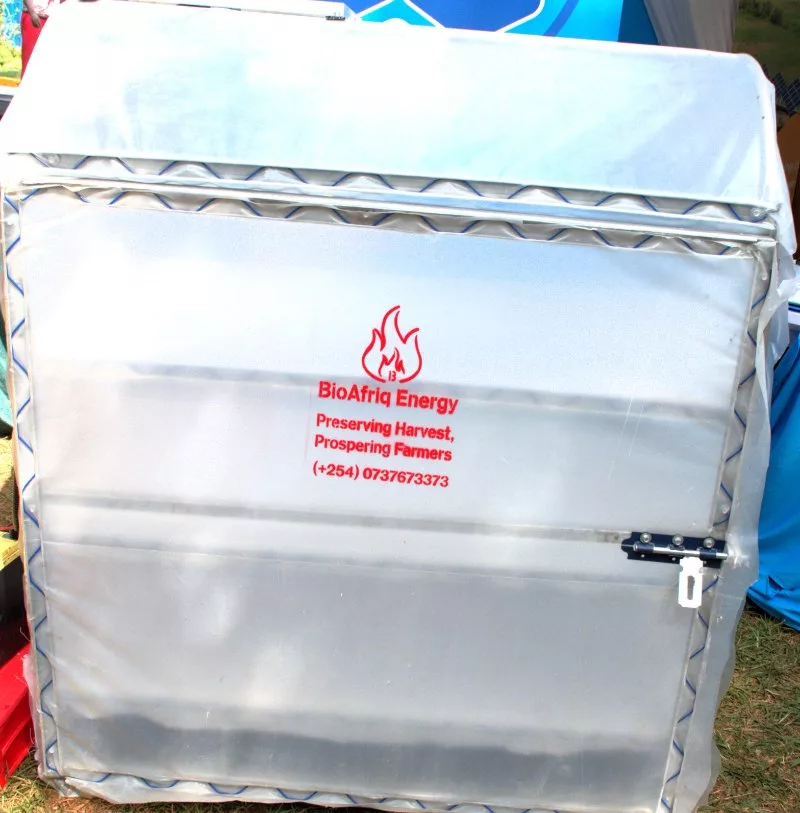 Solar-powered hybrid food dehydrators./AGATHA NGOTHO.