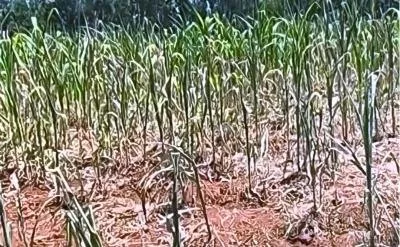
 Poor maize crop condition on a farm./FILE.
Kenya could be headed for a maize shortage if the ongoing
drought affecting several parts of the country continues.
Farmers in different parts of the country, including key maize-growing regions, are reporting poor crop performance due to inadequate rainfall, raising concerns over reduced harvests during the next long-rains harvesting season.
This comes as the Kenya Meteorological Department has warned of evolving weather conditions in the coming months.
The National Drought Management Authority (NDMA) has reported worsening drought in parts of the country, particularly in the arid and semi-arid counties.
James Kariuki, a farmer from Bidii on the outskirts of Kitale, said the maize on his farm was performing poorly and he feared this would result in a poor harvest.
"Most of the time I plant more than 10 acres and harvest between 300 and 350 bags. But this year it will be difficult to even get 150 bags. Even if it rains now, looking at this maize, we will still incur losses," Kariuki said.
"The sun has been too intense and there are sections of my farm where I will not harvest anything because the crops have completely dried up."
Another farmer from Cherangany said the drought had hit hard and the maize crop in the fields was in poor condition, which could result in a serious maize shortage in the coming months.
According to the National Drought Early Warning Bulletin released by the NDMA, early-planted crops and areas that received sustained rainfall are showing favourable maturity, with active harvesting taking place across the ASAL counties.
However, an early end to the seasonal rains, combined with a dry June, has triggered localised moisture stress, reduced yield prospects and potential crop failures in parts of Kilifi, Kitui, Makueni and Laikipia.
"In the agro-pastoral zones, performance remains highly polarised. While Narok and Kajiado expect strong, near-normal harvests that will boost local food availability,” the NDMA report showed.
“Counties like West Pokot and Nyeri are struggling with below-average conditions due to a combination of early-season nutrient leaching, frostbite and subsequent dry weather."
Prof Hamadi Boga, Vice President Program Delivery, AGRA, noted that the devastating impacts of drought in North Eastern Kenya and the wider Horn of Africa are recurring challenges.
He cautioned that Kenyans tend to be reactive rather than deliberate and proactive in planning for the region.
He pointed out that both the national and county governments have a responsibility to build community resilience against the severe climate shocks that frequently devastate these areas.
"This requires investing in water storage infrastructure and providing crop and livestock insurance to compensate for losses," Boga told the Star.
"We must also support communities by promoting food diversification through the introduction of drought-tolerant, short-maturity crops that mature in just one to two months, and by diversifying into other value chains such as poultry to ensure access to a healthy diet," he added.
He said long-term planning must prioritise rainwater harvesting during wet seasons, sinking boreholes and active water conservation.
Boga also noted the important role of cash transfers in keeping local economies afloat during crises, preventing business closures and protecting community livelihoods.
He urged farmers to embrace climate-smart agriculture, focusing on key fundamentals such as irrigation, drought-tolerant crop varieties, good agronomic practices and reducing post-harvest losses, which can currently reach as high as 40 per cent in some value chains.
Boga said according to the Agricultural Growth and Transformation Strategy, resilience is a core pillar of the framework.
"As we plan, we must work hand in hand with local communities to address these challenges, ensuring we respect and integrate their specific geographical realities and cultural norms," he said.