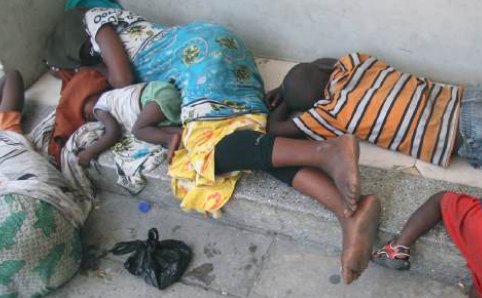
Nearly seven in 10 female street persons have given birth
and most still raise their children on the streets, the recently published
census has shown.
The 2025 National Census for Street Families, published this month by the Street Families Rehabilitation Trust Fund and the Kenya National Bureau of Statistics, found that of 3,209 female respondents aged 10 and above, 69.9 per cent—2,243 women—had given birth.
Among them, 58.2 per cent were living with their children on the streets, including two-thirds of mothers aged 10 to 24 years.
“Females reported higher proportions born in the streets at 14.6 per cent,” the census noted, compared to 7.9 per cent of males.
Nairobi, Mombasa and Nakuru host the highest numbers of mothers living with children on the streets, followed closely by Kiambu and Uasin Gishu.
Nyandarua, Lamu and Tana River recorded the lowest populations of street persons.
The census recorded that female street persons have borne 3,608 biological boys and 3,318 biological girls, with an additional 328 foster boys and 311 foster girls.
Gender, Culture and Children Services CS Hanna Cheptumo said the government remains committed to the principle of leaving no one behind.
“Data shows that the majority of street persons were aged between 18 to 34 and children,” Cheptumo said.
“This report provides very valuable information for planning and allocation of resources for responding to the needs of the most vulnerable populations in our society.”
The CS also acknowledged that street families face unpredictable and often hostile problems including sexual exploitation and lack of basic sanitation.
Marriage patterns reveal instability. Among street persons aged 12 and above, 59.1 per cent have never married.
While 12.3 per cent are in monogamous unions, 3.6 per cent cohabit, 18.6 per cent are separated and 6.3 per cent are widowed.
Separation is notably higher among females at 28.4 per cent compared to 16.1 per cent of males, particularly for those aged 25 to 49.
Widowhood reaches 19.9 per cent among those aged 60 and above.
Sexual activity is widespread: 72.5 per cent of all street persons aged 10 and above have ever had intercourse, rising to 87.0 per cent among females.
Yet only 41.2 per cent used a condom during their most recent encounter, with use lowest among children aged 10 to 14 at 20.6 per cent.
SFRTF chairperson Mary Wambui called for stronger institutional coordination to address governance and service-delivery gaps, including educational barriers and exposure to extreme weather conditions and family vulnerabilities.
“A substantial proportion of respondents lack national identification, limiting their access to social protection and financial inclusion initiatives. Family-based vulnerabilities are also evident, reinforcing the importance of strengthening tracing, reunification and community reintegration frameworks,” Wambui states in the report.
The leading reasons for children separating from families were poverty at 52.2 per cent, corporal punishment at 20.9 per cent, denial of food at 20.2 per cent and parental drunkenness at 18.7 per cent.
Meanwhile, 49.3 per cent of all street children have lost at least one parent and nine per cent are total orphans.
“These drivers point to weak family resilience, limited access to social protection and insufficient community-based prevention systems,” the report states.
The institutional response by authorities remains heavily skewed, presenting a severe hurdle for comprehensive rehabilitation.
Ninety-two per cent of operating rescue and rehabilitation centres focus exclusively on children, leaving an immense service gap for adult street families.
Observers note that fewer than 60 per cent of these facilities offer sustainable economic empowerment initiatives and less than half provide legal aid.
Despite the overall reduction in street numbers from 46,639 in 2018 to 18,049 now, 29 per cent of the population had stayed in the streets for over 10 years, reflecting structural exclusion.
Looking ahead, the report recommends strengthening family reintegration programs, expanding safe shelter and housing solutions and scaling up livelihoods and skills development—targeting the 89.2 per cent of street persons who expressed willingness to leave street life if given the opportunity, with employment (43.9 per cent) and vocational training (41.1 per cent) as their top requested supports.