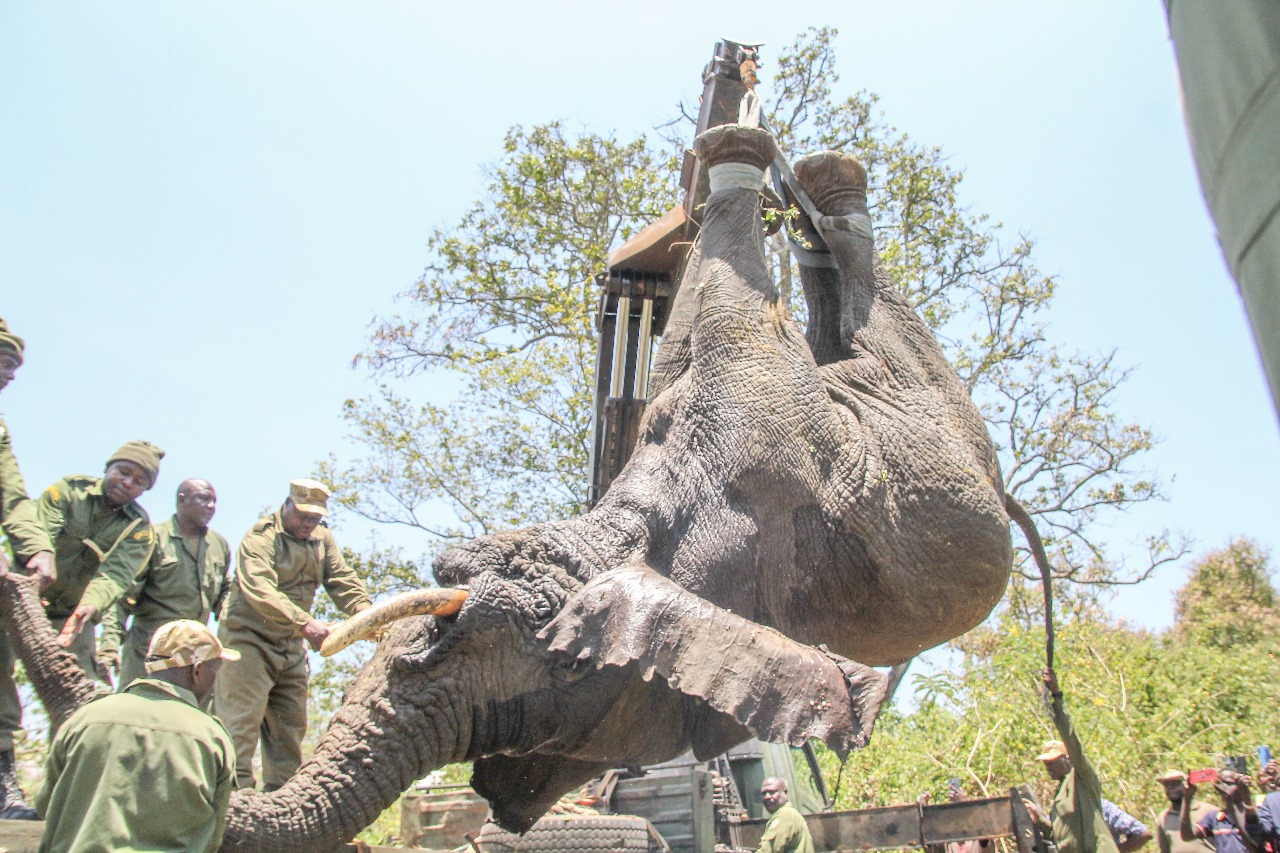
KWS Veterinary and Capture Unit relocates a troublesome bull elephant from Kithoka Village near Imenti Forest, Meru County, to Tsavo East National Park/file
Recent amendments to forest laws have given the state greater authority to allocate forest resources for development purposes, the Green Belt Movement (GBM) says.
The lobby group argues that changes to Section 56(2) of the Forest Conservation and Management Act now empower the Kenya Forest Service to grant easements for public roads, utilities and other installations within public forests.
The amendments have since been signed into law.
Green Belt Movement had opposed the changes, warning that they could open Kenya’s public forests to unchecked infrastructure projects, commercial encroachment and eventual destruction.
The movement said the government was creating what it termed a “dangerous legal pathway” that could allow roads, utilities and public installations to be introduced into protected forests under the guise of development.
Despite its objections, the amendments were passed. Green Belt Movement now argues that the new legal framework could allow protected forest areas to be hived off for various uses.
The organisation has also opposed alleged plans for an airstrip and a golf course in Imenti Forest. It previously raised concerns over proposals to establish a state lodge and golf course in the same forest, citing environmental risks.
In a statement, the movement said it had also seen correspondence dated May 6, 2026, relating to a request for a Special User Licence linked to the construction of a section of the Meru Bypass under the Horn of Africa Gateway Development Project, financed by the International Development Association of the World Bank.
According to the organisation, the proposed road project would affect approximately 2.75 hectares of Imenti Forest. Green Belt Movement said it was seeking clarity on the scope of the developments and their environmental impact.
The movement stressed that public forests play a critical role as water catchments, biodiversity habitats and climate-regulating ecosystems that must be protected for future generations.
It also referenced the recent amendments to the Forest Conservation and Management Act, saying environmental groups had warned that expanded powers on easements and wayleaves could undermine long-term forest protection.
Green Belt Movement insisted that any change of land use within public forests must fully comply with constitutional provisions, environmental laws and public participation requirements.
It questioned how developments such as an airstrip, golf course or state lodge would align with conservation objectives and called for full public disclosure of all plans relating to Imenti and Kambakia forests.
The organisation also urged the World Bank and other development partners involved in the Horn of Africa Gateway Development Project to exercise due diligence and ensure that project financing does not harm protected ecosystems.
Green Belt Movement invoked the legacy of the late Nobel laureate Prof Wangari Maathai, noting her consistent advocacy for forest protection and sustainable development.
It called for the immediate publication of all plans, approvals and environmental assessments linked to the proposed developments and urged Parliament, the National Land Commission, environmental regulators and civil society to remain engaged in the process.
The organisation also raised concerns over alleged plans to encroach on parts of Uhuru Park and Central Park in Nairobi to facilitate the expansion of Uhuru Highway.
It said it had established that survey beacons had reportedly been placed within parts of the parks, warning that this could indicate the early stages of the project.
It insisted that any proposal to excise or change the use of the parks must strictly follow the law, including approval by the Nairobi City County Assembly, public participation, gazettement, clearance by the National Land Commission, an Environmental Impact Assessment and licensing by the National Environment Management Authority.
Green Belt Movement said Uhuru Park and Central Park are gazetted public recreational spaces held in trust for present and future generations.
It warned that the continued loss of urban green spaces threatens biodiversity, climate resilience, public health and the constitutional right to a clean and healthy environment.
The concerns come amid growing pressure on Nairobi’s green spaces from infrastructure expansion, commercial interests and changing land use patterns.
GBM has since petitioned several government agencies, including the Kenya National Highways Authority (KeNHA), Nairobi City County Government, the National Land Commission, NEMA, the Ministry of Roads and Transport and the Ministry of Lands, seeking clarity on the proposed developments.
It wants KeNHA to disclose whether any portion of the parks will be acquired, the exact acreage involved and the legal basis for any acquisition. It is also seeking details on whether environmental, social or feasibility studies have been conducted and whether they are publicly available.
The lobby group also wants City Hall to confirm whether public participation has been undertaken, including the dates and records of consultations.
It has asked the county assembly to state whether it has considered or approved any proposal affecting the parks.
Similarly, the organisation has asked the National Land Commission to clarify whether it has received or approved any request for acquisition or change of use, while NEMA is being asked whether any Environmental Impact Assessment has been submitted or approved.
The organisation reiterated that the Constitution guarantees public participation in decisions affecting public land and resources, and that Kenyans have a right to transparency and consultation.
It said the protection of Uhuru Park, in particular, remains symbolic of Kenya’s environmental justice struggle championed by Prof Wangari Maathai.