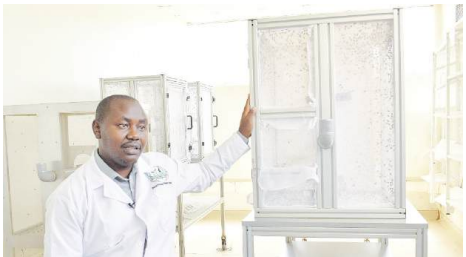
The Kenya Agriculture and Livestock
Research Organization is involved in
the production of maggots for clinical therapy, a method of treating
non-healing or infected wounds.
A wound is defined as chronic or
non-healing if it takes more than
three weeks to heal and this presents
a huge burden for patients and their
families.
Maggot debridement therapy
involves using sterilised fly larvae
(maggots) that feed on dead tissue
and bacteria in a wound, effectively
cleaning it and promoting healing.
Paul Ngare from the Biotechnology
Research Institute at Kalro Muguga
says they have been working on various technologies including maggot
therapy.
“We use the green butterfly larvae
to manage chronic wounds. The larvae normally eat the dead necrotic
tissue from the wounds and feed on
harmful bacteria and the secretion
which has enzymes destroys these
harmful bacteria and provide a protective layer on the surface of the wound,” he explained.
Ngare noted
that maggot therapy is not a very new
technology in Kenya, as it was introduced back in 2013 through the aid
of the Syrian government.
The groundwork was laid through
collaborative research between Kalro,
the University of Nairobi and Kenyatta National Hospital.
Maggot therapy was a common
form of treatment in early civilizations, but with bacteria developing
resistance to the antibiotics, healthcare practitioners are now reverting
to maggot therapy as an alternative to
treat wounds, especially chronic ones.
Ngare explained that sometimes
a patient might have another underlying condition, resulting in him or
her being immuno-compromised and
thus resistant to the bacteria.
Biotherapy, also known as immunotherapy, uses substances derived
from living organisms to treat diseases and is thus important in management of such wounds.
Besides health, he noted that the
advantage of maggots is if used in
forensic research, they can be applied
to conversion of waste to useful protein by allowing them to grow to the
third instar larvae which is normally
10 to 20 millimetres and used as animal feeds once dried.
“Maggots are
very rich in protein, which is about
60 percent protein, making it about
twice the composition of protein in
soil and can be mixed in animal feeds
in the right proportions for feed formulation,” Ngare said.
In 2012, KNH and UoN approved
a pilot study on maggot therapy.
The study was conducted between
August and December 2013 at KNH.
Twenty-four patients were treated
with 30 maggot applications.
Kalro is running an open week
where farmers and the general public can engage scientists on various
technologies.