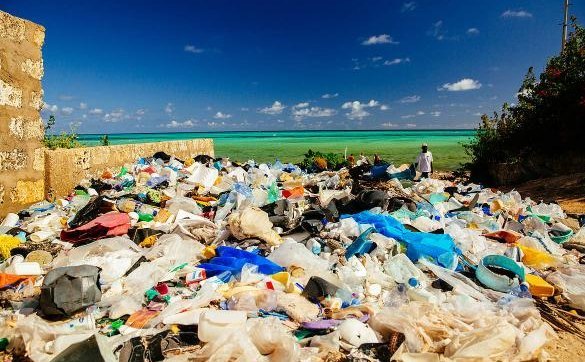
Marine waste /FILE
Discarded sanitary pads are increasingly finding their way into Kenya’s oceans, raising concern among marine scientists over the growing threat of plastic pollution to marine ecosystems and fisheries.
Justus Andati, a marine scientist at the Kenya Marine and Fisheries Research Institute (KMFRI), said surveys along the Kenyan coastline have identified sanitary pads as one of the major sources of plastic waste entering the ocean.
He said findings from last year’s survey pointed to an emerging and largely overlooked source of marine pollution.
“One of the biggest sources of plastic waste we identified was sanitary pads,” he said.
"We need to think as a country about how we dispose of them and what biodegradable materials can be used so that fish are not choked by this waste. Most of these materials find their way into the ocean through surface runoff."
Andati said many conventional sanitary pads contain plastic components that can take hundreds of years to decompose. Once in the ocean, they break down into microplastics that can be ingested by fish and other marine organisms, eventually entering the food chain.
Researchers are currently conducting a comprehensive ecosystem survey aboard the research vessel Dr Fridtjof Nansen, covering Kenya’s marine waters from the southern coast through the Pemba Channel to Kiunga in Lamu county.
“Basically, we are doing an ecosystem survey to assess the general health of our marine ecosystem and the status of the fisheries in our waters,” Andati said.
The survey is being undertaken through a partnership between KMFRI, the Food and Agriculture Organisation of the United Nations (FAO) and the Norwegian government.
Andati said the current survey is more extensive than last year’s exercise. While the previous survey covered 18 stations, this year’s work spans 30 stations across seven transects, where scientists are collecting water samples and analysing ocean health indicators.
Among the key concerns under investigation is plastic pollution, which scientists warn is becoming one of the most serious threats to marine ecosystems.
“Offshore, we are able to detect massive plastic contamination in our waters. As a country, we need to tackle this because research has shown that if we do not mitigate plastic pollution, we could end up having more plastics than fish in our water bodies in future,” he said.
According to the United Nations Environment Programme (Unep), Kenya generates about 22,000 tonnes of plastic waste annually, a significant proportion of which ends up in rivers and eventually the Indian Ocean.
Previous studies along the coast have also found plastic debris on beaches, in mangrove ecosystems and in the stomachs of marine animals, including fish, turtles and seabirds.
Beyond pollution monitoring, the survey is also studying fish larvae to help scientists understand breeding patterns and predict future fish stocks.
“The presence of fish larvae is an indication of breeding and spawning periods. This information helps us advise management agencies on conservation measures, such as seasonal closures,” Andati said.
He noted that data from last year showed slight improvements in ecosystem health and fish stocks, partly due to conservation efforts and attempts to reduce plastic pollution, but warned that more action is needed.
He urged stronger public awareness and policy action, warning that unchecked pollution threatens both marine life and human survival.
The survey is part of the EAF-Nansen Programme, a long-running partnership involving FAO, Norway and 33 countries across Africa and the Bay of Bengal, which has supported marine research since 1975 and contributed to the discovery of 91 new marine species worldwide.