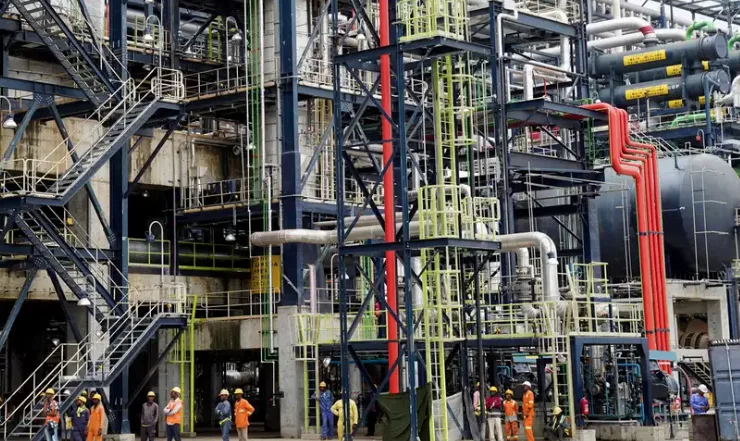
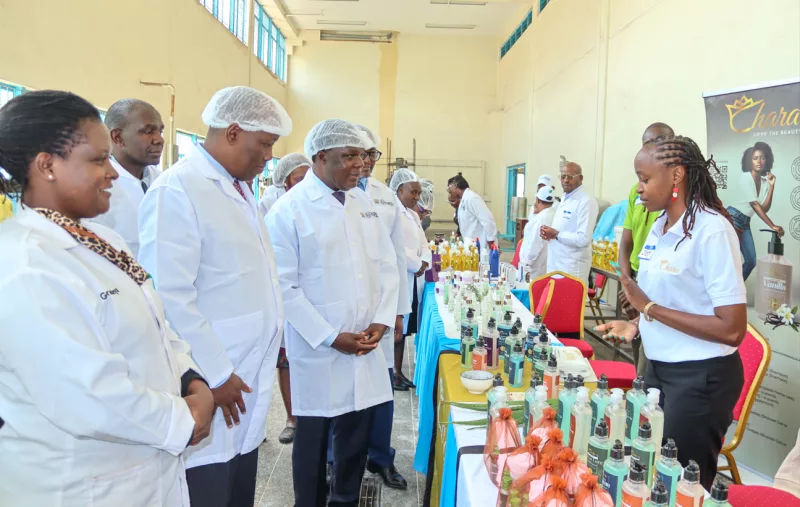
 Kenya Industrial Research and Development Institute Senior Research Scientist Bevin Kundu takes Investments, Trade and Industry CS Lee Kinyanjui, Industry PS Juma Mukhwana and KIRDI board chairman Peter Mositet through the chemical engineering and natural product plant, at the KIRDI headquarters in Nairobi / HANDOUT
The government is banking on investment in industrial research, innovation and technical skills development to position Kenya as a regional manufacturing hub.
This, it says, will enable the country to support multi-billion-shilling investments coming into the country while creating jobs for thousands of young people.
The renewed focus comes as Kenya continues to attract
large-scale industrial investments, including the planned construction of a $17
billion (Sh2.2 trillion) oil refinery in Lamu by Nigerian billionaire Aliko
Dangote.
The project is expected to significantly boost demand for highly skilled technical workers.
Investments, Trade and Industry CS Lee Kinyanjui said the country must develop the technical workforce needed to support such projects, warning that Kenya risks missing employment opportunities if local skills do not match industry needs.
Speaking during a tour of the Kenya Industrial Research and Development Institute (KIRDI) and an inspection of the under-construction KIRDI Techno Centre in South B, Nairobi, Kinyanjui said the government is repositioning the institution to become the country's flagship industrial innovation and skills development hub.
"We have a huge refinery coming up in Lamu and the entire construction will require specialised skills. We want to know where the welders and other technical personnel needed for such projects will come from," he said.
He said the ministry is also working closely with stakeholders in the maritime and shipbuilding sectors to develop specialised training programmes, enabling Kenyans to take up skilled positions in emerging industries.
To accelerate the plan, National Treasury has allocated an additional Sh3.4 billion in the 2026-27 financial year to complete the long-delayed KIRDI Techno Centre.
The project, whose cost has risen to about Sh8.56 billion from the original estimate of roughly Sh5.9 billion, because of funding and procurement delays, is expected to be completed by the end of 2027.
Once operational, the facility will house advanced research laboratories, pilot manufacturing plants, product testing facilities and business incubation centres designed to help innovators commercialise locally developed technologies.
The centre is also expected to provide manufacturers, researchers and entrepreneurs with access to modern industrial equipment and technical expertise to improve the quality and competitiveness of Kenyan products in domestic and export markets.
Kinyanjui said the government is expanding KIRDI's role beyond Nairobi by rolling out county-based training programmes tailored to the economic activities of different regions.
Rather than offering uniform programmes across the country, he said each county will receive specialised training based on its economic strengths, with pastoral counties focusing on livestock value addition while agricultural regions receive support in food processing and agro-industrial technologies.
Bringing industrial training closer to entrepreneurs, he said, will reduce the cost of accessing technical expertise, promote innovation among youth and women, minimise post-harvest losses and help small businesses comply with quality standards required for local and international markets.
The government also wants to shift the mindset of young Kenyans from seeking employment to becoming manufacturers and entrepreneurs capable of creating jobs.
Through KIRDI's common-user facilities, aspiring entrepreneurs will receive support in product development, testing, branding and commercialisation before entering the market.
The ministry is further exploring financing arrangements that would connect graduates of KIRDI training programmes with lenders, including the Kenya Development Corporation (KDC), to enable them to scale up their businesses.
"Government may not employ everybody, but it can create the right incentives for people to employ themselves and build businesses that create jobs," Kinyanjui said.