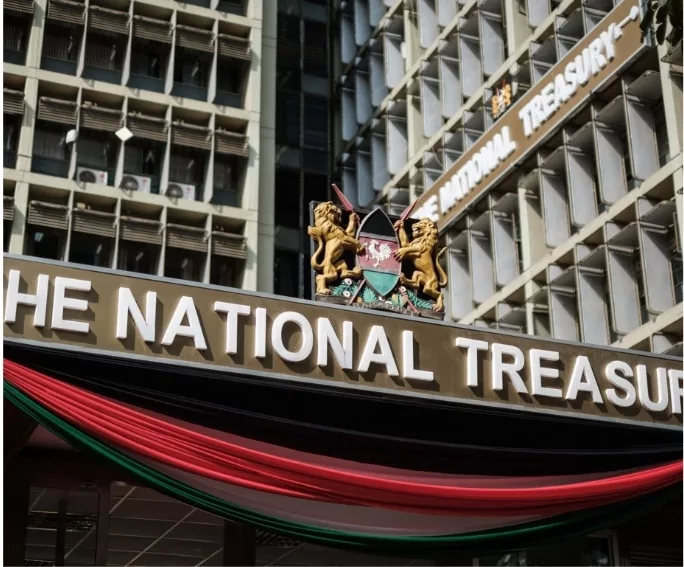
 The National Treasury building in Nairobi
To attain this, the government plans to issue a new dollar-denominated bond to refinance the transaction and lengthen the country's debt repayment profile.
The proposal, contained in the National Treasury's latest Medium-Term Debt Management Strategy, marks the fourth external debt buyback in two years.
The exchequer seeks to reduce refinancing risks and avoid large bullet repayments that have previously rattled investors.
Treasury says proceeds from the planned Eurobond issue will primarily finance the buyback, with any excess funds directed towards budget financing to help plug the government's financing gap.
Details on the planned dollar-denominated bond remain scanty, with a senior treasury official versed with the plan saying that they are yet to conclude on a specific figure.
"These details will be made known to you. What I can tell you is that the buyback plan is decided," he said.
The strategy is part of a broader effort to smooth Kenya's external debt repayment schedule while reducing pressure on public finances over the next few years.
National Treasury Cabinet Secretary John Mbadi has previously described the buyback strategy as part of a "proactive debt management strategy" aimed at improving the country's debt maturity profile rather than accumulating new expensive debt.
He has maintained that Kenya is focused on refinancing existing obligations with longer-dated instruments to reduce immediate repayment pressure.
The buyback strategy represents a sharp departure from Kenya's earlier dependence on issuing Eurobonds simply to finance spending.
Instead, the exchequer is increasingly using liability management operations to retire near-term obligations before they mature and replace them with longer-term debt carrying more manageable repayment schedules.
Economists say the approach reduces rollover risk, reassures investors and helps avoid sudden spikes in external debt servicing.
"By spreading repayments over a longer period, the government also creates fiscal space to finance development and essential public services instead of facing large one-off repayments," economist Elisha Amwai told the Star.
Kenya's new strategy follows a series of successful liability management operations.
In 2024, the government raised $1.5 billion (Sh193.8 billion) through a Eurobond and used most of the proceeds to retire a large portion of the $2 billion (Sh258.4 billion) bond that matured in February 2024, easing fears that the country could default.
At the time, concerns over Kenya's ability to repay the bond had sent borrowing costs soaring, while investors demanded higher yields on Kenyan debt.
The successful refinancing helped restore confidence in international markets and stabilised the country's sovereign credit outlook.
Since then, the government has undertaken additional buybacks, including refinancing portions of bonds maturing in 2027, 2028 and 2032.
The latest planned transaction would continue that strategy by pushing repayments further into the next decade.
Treasury is also diversifying its external financing sources beyond conventional Eurobonds.
Besides tapping the Japanese Samurai bond market, Kenya recently secured World Bank-backed financing, including a sustainability-linked facility designed to lower reliance on expensive commercial borrowing.
The government has also converted some Chinese loans into yuan-denominated debt to reduce financing costs and currency risks.
The latest debt management plan comes as Kenya continues to grapple with a heavy public debt burden.
Treasury estimates public debt stood at about Sh12 trillion, equivalent to about 68 per cent of gross domestic product at the end of March.
Interest payments continue to consume a significant share of government revenue, limiting spending on development priorities.
The World Bank has repeatedly warned that Kenya's debt servicing obligations remain one of the biggest constraints on economic growth.
While the lender recently approved fresh budget support and a sustainability-linked financing package, it noted that reducing dependence on costly commercial borrowing remains critical for maintaining fiscal sustainability.