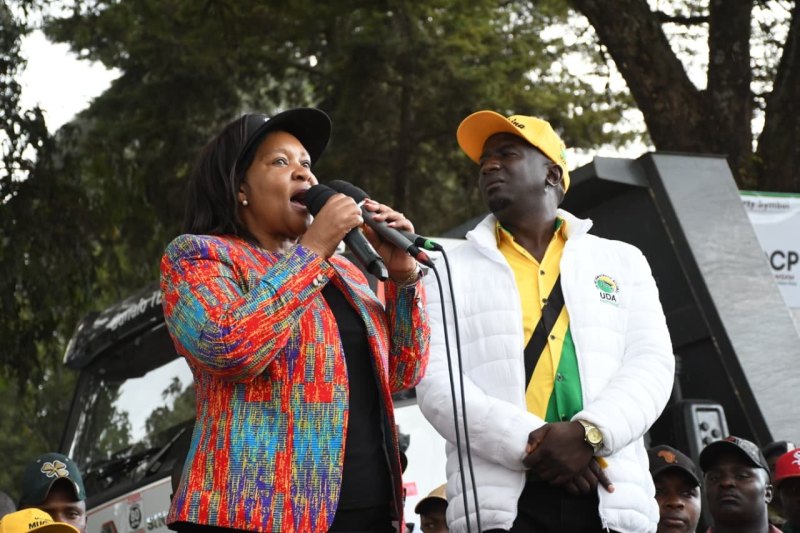
Bars, Hotel and Liquor Traders Association of Kenya (BAHLITA) Secretary General, Boniface Gachoka addresses the media during a forum in Nakuru/ HANDOUT
CALLS to halt deliberations on the proposed Tobacco Control (Amendment) Bill and conduct comprehensive nationwide public participation now continue to widen across the country, amid warnings of a rise in illicit trade.
Traders under the Bars, Hotel and Liquor Traders Association of Kenya (BAHLITA) in other counties away from Nairobi, including Nakuru, and Uasin Gishu, are urging the National Assembly to conduct comprehensive nationwide public participation.
They warn that failure to consult affected businesses could trigger a surge in illicit trade, threaten thousands of jobs and cost the government billions of shillings in lost revenue.
This, amid concerns that Parliament's Departmental Committee on Health is sidelining ordinary business operators from by holding stakeholder engagements largely in Nairobi, excluding many traders from other parts of the country whose livelihoods could be directly affected by the proposed law.
According to BAHLITA secretary general Boniface Gachoka, public participation is a constitutional requirement and not a procedural formality.
"When traders, the very people whose businesses will be affected by this law, are excluded from the process, that is an affront to a right guaranteed to every Kenyan under the Constitution," he said.
The traders have cited Articles 10 and 118 of the Constitution, arguing that Parliament has an obligation to ensure citizens and stakeholders meaningfully contribute to legislation before it is enacted.
"We understand the Committee is holding targeted meetings with select stakeholders in Nairobi who do not represent the face of Kenya," BAHLITA chairman for Uasin Gishu County, Hollian William Lodenyo noted.
At the centre of the dispute is a proposal to ban flavoured nicotine and tobacco products, a move traders fear could unintentionally drive consumers toward untaxed and unregulated products supplied through illegal channels.
According to industry stakeholders, restrictive regulations that fail to consider market realities often create opportunities for illicit traders, undermining legitimate businesses that comply with tax and regulatory requirements.
The concerns mirror those raised by British American Tobacco Kenya (BAT Kenya), which has also petitioned lawmakers to reconsider several provisions of the Bill.
In submissions to the National Assembly's Health Committee, BAT Kenya
welcomed efforts to regulate emerging nicotine products but cautioned against
adopting a “one-size-fits-all” regulatory framework that treats conventional
cigarettes and reduced-risk alternatives in the same manner.
The company argues that products such as nicotine pouches, heated tobacco devices and electronic nicotine delivery systems should be regulated according to their risk profiles, rather than being subjected to identical restrictions.
BAT has noted that illicit cigarettes already account for approximately 45
per cent of Kenya's cigarette market, resulting in annual tax revenue losses of
about Sh12 billion.
Uganda is a main source of illicit and counterfeit cigarettes finding their way into Kenya.
Stakeholders say tougher restrictions without corresponding enforcement measures could worsen the problem, creating a thriving black market while reducing sales of regulated products.
The debate comes at a time when governments worldwide are grappling with how to regulate rapidly evolving nicotine products, as global tobacco companies increasingly diversify away from traditional cigarettes toward smoke-free alternatives.
Kenya's tobacco value chain supports more than 100,000 livelihoods through farming, manufacturing, distribution, retailing and related services.
Industry players argue that abrupt regulatory changes could destabilise the sector, discourage investment and reduce Kenya's competitiveness compared to neighbouring countries.
Several private sector organisations, including the Kenya National Chamber
of Commerce and Industry, the Retail Trade Association of Kenya (RETRAK) and
the Kenya Association of Manufacturers (KAM), have also expressed reservations
about aspects of the Bill.
The groups argue that some provisions risk over-regulating the industry, increasing compliance costs and creating regulatory overlaps that could particularly hurt micro, small and medium-sized enterprises.
Business lobby groups have also opposed proposals that seek to introduce tobacco-specific plastics restrictions, arguing that existing Extended Producer Responsibility frameworks already provide mechanisms for waste management and recycling.
The outcome of the Tobacco Control (Amendment) Bill is expected to shape the future of Kenya's nicotine market, and determine whether the country can effectively combat illicit trade while maintaining a competitive and well-regulated industry.