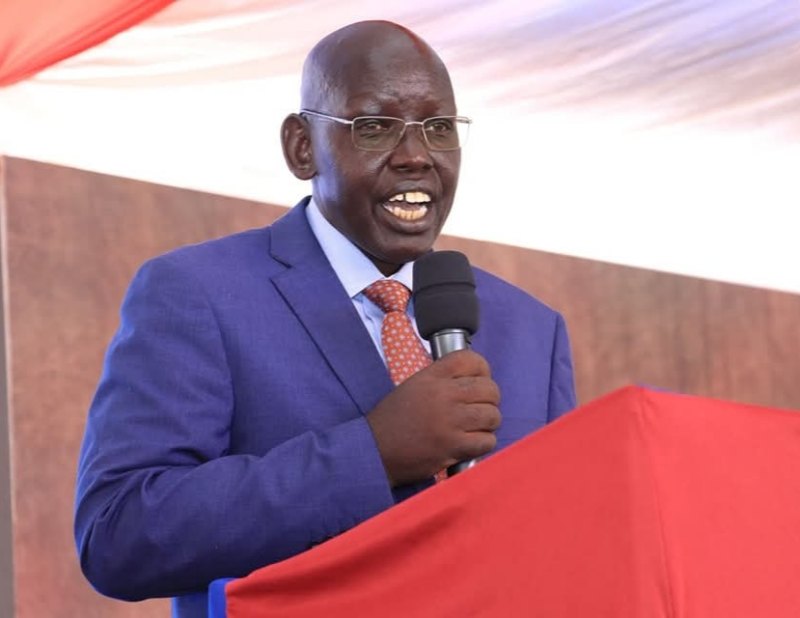
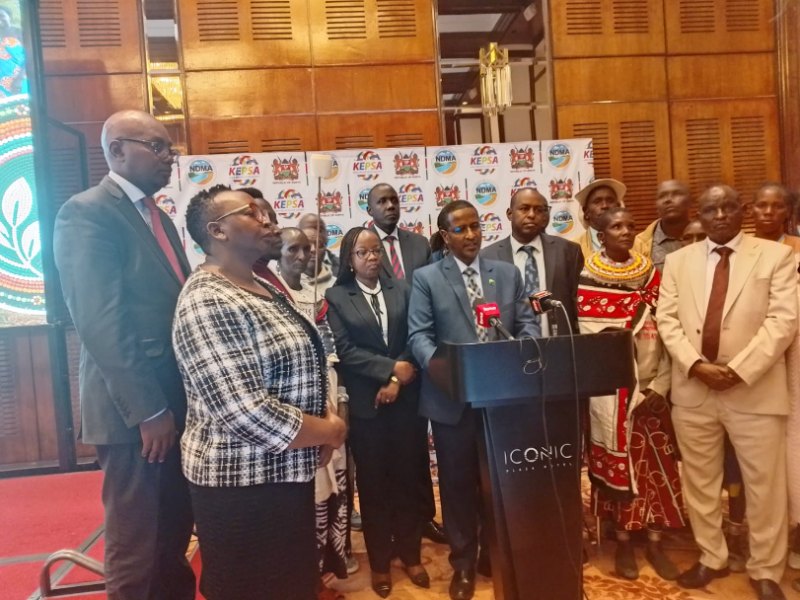
 National Drought Management Authority CEO Hared Adan flanked by the authority’s chairman Shallow Yahya, private sector representatives and members of ASAL community, speaks during a strategic private sector forum on drought resilience and ASAL Investments, in Nairobi / MARTIN MWITA
The government is intensifying efforts to attract private sector investment into drought resilience projects across Kenya's arid and semi-arid lands (ASALs).
This, as it seeks to shift the country's approach from costly emergency responses to long-term economic resilience.
This emerged during a Strategic Private Sector Forum on Drought Resilience and ASAL Investments convened in Nairobi on Monday by the National Drought Management Authority (NDMA), in partnership with the Kenya Private Sector Alliance (Kepsa).
The forum brought together senior government
officials, financiers, development partners and private sector leaders, with participants
agreeing that drought should no longer be viewed solely as a humanitarian
challenge, but as a major economic and business risk requiring sustained
investment.
NDMA board chairman Shallow Yahya said recurring droughts continue to inflict significant losses on businesses and communities by disrupting production, weakening markets and increasing operational costs.
"Every drought destroys economic value, whereas every investment in resilience creates it. The question before us is not whether we should invest but whether we can afford not to," he said.
Kenya's ASAL regions account for about 80 per cent of the country's landmass and support millions of people as well as a substantial proportion of the national livestock herd.
However, the regions remain highly vulnerable to climate shocks and water scarcity.
NDMA chief executive Hared Adan said the government has already laid the groundwork for large-scale investments through policy reforms, technical expertise, community participation and the identification of investment-ready projects.
"We can continue financing emergencies, or we can invest in resilience to reduce future losses and create lasting value. We believe the latter is the better investment," he said.
According to the authority, Kenya spent approximately Sh71 billion responding to the last severe drought.
Officials argue that a fraction of such resources, if invested proactively in resilience-building measures, would significantly reduce future losses.
The government has already committed substantial resources toward drought resilience.
During the current financial year, has invested about Sh400.1 million in resilience projects, with over 80 per cent directed towards water infrastructure.
The European Union, a development partner, have also contributed Sh184.4 million towards the programmes.
NDMA revealed that through Participatory Disaster Risk Assessments conducted across drought-prone wards, more than 630 community-prioritised resilience projects have been identified.
Nearly half of these projects however remain unfunded, creating opportunities for private sector participation.
At the forum, four investment-ready projects from Laikipia, Samburu, Isiolo and Meru counties were presented to potential investors as pilot initiatives.
The projects, largely focused on water infrastructure, have already undergone technical assessment and community validation, making them ready for implementation.
Other priority investment areas include renewable energy, climate-smart agriculture, livestock value chain development, climate finance, insurance products and digital technologies for drought risk management.
Head of Kepsa consult, senior circular economy and climate change coordinator, Jackson Koimbori, said private sector recognises the growing economic risks posed by climate change and is willing to commit resources, provided there is a structured framework for engagement.
"We have seen that NDMA has done a good job identifying more than 600 projects. What is needed now is a platform where the private sector can assess these opportunities and determine where to invest," he said.
Koimbori also called for innovative financing mechanisms, including blended finance, climate financing, insurance products and Environmental, Social and Governance (ESG)-linked investments.
He noted that the recent introduction of the Green Finance Taxonomy by the Central Bank of Kenya could provide a framework for banks and investors seeking to support climate resilience projects.
Another key proposal emerging from the forum was the establishment of a permanent public-private engagement platform to coordinate investments, share knowledge and accelerate project implementation.
Participants further called for improved climate data systems, stronger drought early warning mechanisms and enhanced investment intelligence to support informed decision-making.
NDMA said Kenya's drought monitoring systems have significantly improved and currently indicate “normal” conditions across all monitored counties.
However, it cautioned that climate variability remains a persistent threat requiring sustained preparedness.
Both government and private sector stakeholders committed to deepen collaboration and mobilise investments capable of transforming drought-prone communities into resilient economic hubs.
With hundreds of bankable projects awaiting funding and climate shocks becoming more frequent, stakeholders said unlocking private capital could prove critical in safeguarding livelihoods, protecting businesses and driving sustainable growth across Kenya's vast ASAL regions.
![[PHOTOS] Raila Odinga Stadium construction enters home stretch](https://cdn.radioafrica.digital/image/2026/06/45f6990c-4882-4cd2-b83c-8fc730dcdce5.jpg)