The government is eyeing private sector capital for climate adaptation projects as drought resilience now turns into one of Kenya’s most promising investments
Led by the National Drought Management Authority
(NDMA), government is hopes to have billions channeled into initiatives that safeguard livelihoods, secure water resources and deliver sustainable
commercial returns across the country’s drought-prone regions.
The Arid and Semi-Arid Lands (ASALs), which cover about 80 per cent of the country’s landmass are among Kenya’s greatest untapped investment frontiers, rich in natural and strategic resources and high growth opportunities.
These landscapes offer significant opportunities for
agriculture (including livestock), energy, tourism and conservation.
NDMA is hence positioning climate resilience not merely as a humanitarian concern but as a business and economic opportunity, arguing that every sector, from agriculture and manufacturing to banking, insurance and logistics, as a direct stake in reducing drought-related risks.
According to the authority, drought should increasingly be viewed as a business continuity challenge with significant implications for supply chains, production and market stability.
The push comes as Kenya grapples with increasingly frequent and severe climate shocks that have disrupted agricultural output, strained water resources and increased vulnerability across arid and semi-arid lands.
“We can continue financing emergencies. Alternatively,
we can invest in resilience to reduce future losses and create lasting value. We
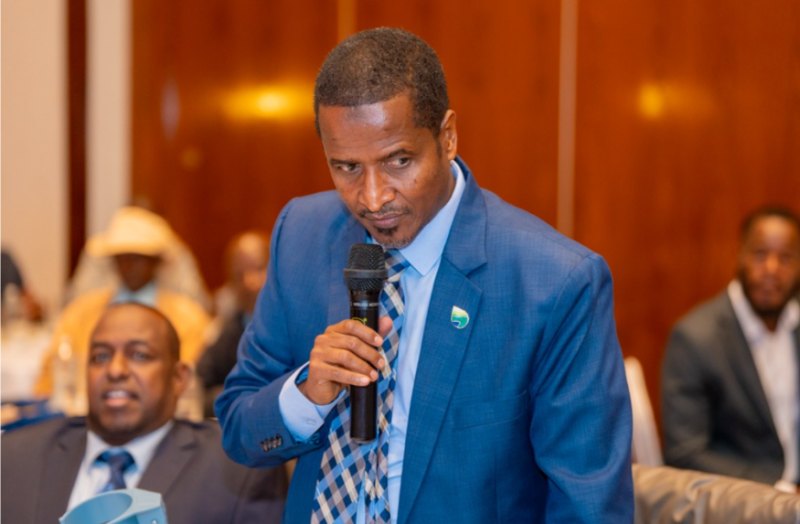
believe the latter is the better investment,” NDMA chief executive, Hared Adan,
said.
He spoke in Nairobi on Monday during a public-private sector forum in collaboration with the Kenya Private Sector Alliance.
He said the government has identified more than 630 community-prioritised resilience projects, and is now seeking partnerships to accelerate scale and mobilise additional financing.
The projects span water infrastructure, irrigation, livestock support and renewable energy-powered water systems designed to strengthen local economies, while reducing dependence on emergency drought interventions.
Among the investment-ready opportunities is the Sh45 million Naitutum pipeline project in Isiolo county, expected to connect communities to reliable water sources and directly benefit more than 9,000 people and 12,000 livestock.
Another opportunity is the Sh35.3 million Koija Earth
Dam project in Laikipia, which aims to provide year-round water access while
boosting agricultural productivity and livestock resilience.
Similar projects include the Sh30 million Lmarmaroi Rock Catchment in Samburu and the Sh20.5 million Nauchi Solarised Water Project in Meru.
The authority argues that such investments generate what it terms a “resilience dividend” by delivering economic, social and environmental benefits simultaneously.
These include improved productivity, reduced eonomic losses, greater market stability, enhanced food security, better health outcomes, watershed restoration and climate adaptation.
For investors, the attraction lies in the growing convergence of climate adaptation and commercial opportunity.
Projects that improve water security can unlock agricultural production, support livestock value chains and create new markets for climate-smart technologies and services.
One example highlighted by NDMA is its drought pellet programme. Since 2016, the authority has distributed specially formulated livestock feed to safeguard breeding and milking animals during drought periods, spending approximately Sh1.3 billion on the intervention.
The agency believes the programme demonstrates a ready-made business opportunity for private firms to commercialise production and distribution at scale.
During the current financial year, the government has invested about Sh400.1 million in resilience projects, with over 80 per cent directed towards water infrastructure, with the European Union contributing Sh184.4 million towards the programmes.
“Government has demonstrated the need and the solution. The private sector can commercialise and scale it,” Adan said.
Head of Kepsa consult, senior circular economy and climate change coordinator, Jackson Koimbori, said private sector is ready to put money in bankable projects, which successfully mitigate risks, yield returns and meet investor and lender expectations.
“The private sector recognises the growing economic risks posed by climate change and is willing to commit resources, provided there is a structured framework for engagement,” he said.
Koimbori called for innovative financing mechanisms, including blended finance, climate financing, insurance products and Environmental, Social and Governance (ESG)-linked investments.
As climate risks intensify, analysts say resilience investments are increasingly moving from the margins of development policy to the centre of economic planning.
![[PHOTOS] Raila Odinga Stadium construction enters home stretch](https://cdn.radioafrica.digital/image/2026/06/45f6990c-4882-4cd2-b83c-8fc730dcdce5.jpg)