

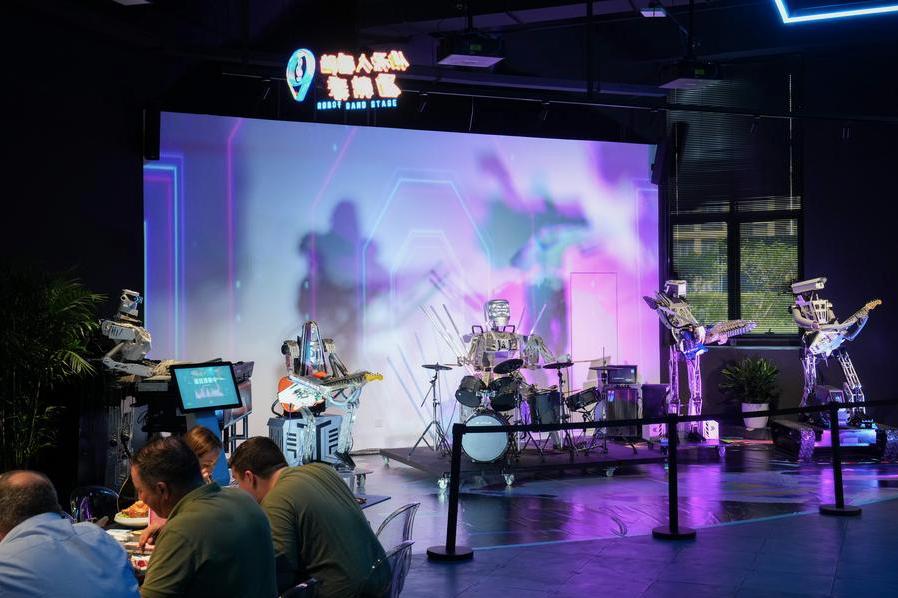
From robotic chefs to AI-powered ingredient tracking and smart reservation systems, intelligent technologies are reinvigorating China's catering industry, elevating consumer experiences while tackling long-standing operational challenges.
At a lively Haidilao hotpot outlet in Beijing, Yang Lin, a regular customer, recently discovered a new digital helper. "Xiaolaolao," the AI assistant, seamlessly handled everything from booking a table to confirming group size and arrival time.
"It's convenient to just speak to it. I've never seen anything like this before," Yang said.
According to Haidilao, "Xiaolaolao" goes beyond bookings, offering tailored suggestions like low-fat options for health-conscious diners or children's meals for families. Yang tried its smart bill-analysis feature, which helps optimize coupon usage and alerts customers to unused membership benefits, adding yet another layer of convenience.
Smart tools such as Haidilao's AI assistant are becoming bright spots for an industry seeking fresh momentum.
While data from the National Bureau of Statistics shows a modest 3.3 percent year-on-year rise in catering revenue to 4.62 trillion yuan (about 652.6 billion U.S. dollars) from January to October 2025, data from Meituan shows rising store closures and volatile new openings, signaling increasingly fierce competition.
Traditional restaurants in China are grappling with challenges such as product homogeneity, high operating costs, low efficiency and limited service scenarios, according to an industry report published by Hongcan, a catering research institute.
Experts believe that overcoming these constraints and achieving sustainable growth will require embracing new technologies to carve out a new development path.
HEYTEA, a renowned Chinese beverage brand, has equipped its stores with self-developed devices, including smart tea brewers, scales and tea-making assistants, enhancing operations at multiple stages. For instance, manually peeling a basket of green grapes takes 15 minutes, while an automatic peeler completes the task in just one minute.
Meanwhile, JD.com's 7Fresh Kitchen in Beijing, which specializes in stir fries, snacks, fried rice and noodles, has introduced cooking robots.
Similarly, at Juneyao Air's cafeteria, where thousands dine each day, cooking robots have greatly improved the cooking process, while AI-powered recognition and calculation systems have helped curb food waste.
"Smart tools and technologies, like AI and automated cooking equipment, help restaurants reduce repetitive labor and optimize operations for leaner management," said Tang Xin, a researcher at Hongcan.
This tech shift is in line with broader national goals. The government has issued guidelines to accelerate the application of new technologies in various consumption scenarios.
He Qing, an industry expert with over a decade of experience in catering intelligence, said that the national push for scenario-based technology adoption suits the catering sector, where AI can improve food safety and healthy eating.
Looking ahead, catering intelligence is evolving from isolated tasks like cooking and coffee-making toward fully integrated digital systems.
Shanghai recently released the country's first provincial-level action plan for intelligent development in catering scenarios. The plan promotes a "smart restaurant" ecosystem, covering central kitchens, food traceability and marketing, and calls for "building pilot projects of leading smart catering integrated scenarios and promoting the application of large models in catering scenarios."
By the end of 2028, the city aims to boost the full-chain intelligentization rate in group catering, fast-food, and beverage enterprises to over 70 percent, the intelligentization rate in key processes of full-service restaurants to over 50 percent, and supply chain intelligent management coverage to over 60 percent.
Experts believe that smart technologies are illuminating the future development path of the industry. "As a rapidly maturing industrial chain drives down costs and boosts efficiency, catering intelligence will see broader adoption, fostering a safer, more efficient industry landscape," He Qing said.