Sources within the opposition say the Nairobi senator can no longer be ignored.
by MOSES OGADA
Audio By Vocalize
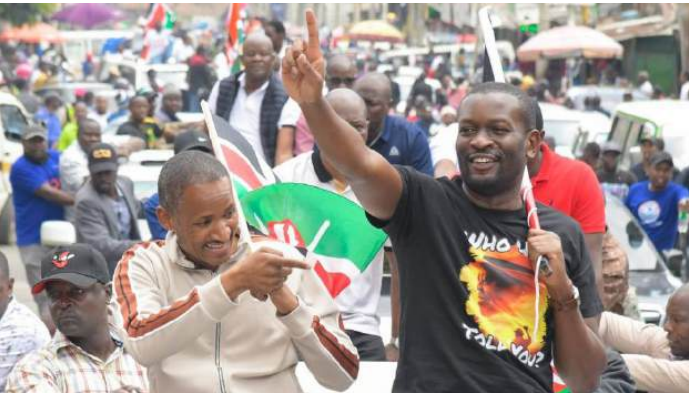
Linda Mwananchi bigwigs, led by Nairobi Senator Edwin Sifuna, addressing a rally in a past rally
Nairobi Senator Edwin Sifuna’s sudden rise among government critics has altered the matrix the opposition was banking on in its bid to unseat President William
Ruto in the 2027 general election.
The Star has established that opposition strategists have
quietly begun recalibrating possible power-sharing arrangements following
Sifuna’s growing influence among anti-Ruto supporters, particularly young
voters and urban constituencies.
Jubilee Party deputy organising secretary Pauline Njoroge
gave the latest indication when she publicly rallied residents behind a working
relationship between Kalonzo and Sifuna.
She defended Kalonzo’s political record while taking a swipe
at Ruto for repeatedly dismissing the Wiper leader as a politician with little to
show for his decades in public service.
“We are asking our leaders, Sifuna, to join hands with
Kalonzo so that they show us the way. All of us are in the one-term camp,”
Njoroge said.
Her remarks immediately sparked speculation within opposition
circles about possible realignments, and what it means for former Interior
Cabinet Secretary Fred Matiang'i's ambitions.
However, when contacted by The Star, Njoroge insisted her
comments were informed by the local political context in Machakos and should
not be interpreted as Jubilee abandoning Matiang’i.
“No, we haven’t given up on Matiang’i’s ticket. We need the
leaders to be together. The Linda Mwananchi candidate is Sifuna. They all need
to sit with Kalonzo and show us the way,” she said.
Njoroge worked closely with former President Uhuru Kenyatta
and is often seen as reflecting sentiments within the Jubilee establishment.
However, a source familiar with ongoing opposition
consultations told The Star that Sifuna’s growing popularity has become
impossible to ignore.
Key figures in the broader opposition alliance are
increasingly discussing ways of accommodating the Nairobi senator in any
eventual coalition structure.
Some within the coalition reportedly view Sifuna and Kalonzo
as a potentially formidable ticket capable of balancing experience with
youthful appeal.
In the talks, Jubilee is reportedly being persuaded to settle
for a Prime Cabinet Secretary position while Kalonzo and Sifuna occupy
the top two slots.
Sources indicate they are borrowing heavily from the bipartisan
National Dialogue Committee (Nadco) framework, especially its more inclusive
executive structure.
Interestingly, Njoroge herself appears to have been testing
public sentiment regarding possible political combinations.
In recent social media engagements, she has repeatedly asked
followers to propose combinations of president, deputy president and prime
minister.
The emergence of Sifuna comes at a delicate moment for
opposition politics, with ODM split into two factions.
Sifuna’s revolt, his confrontational style, frequent public
engagements and unwavering criticism of the broad-based arrangement have
elevated his profile nationally.
Political commentator and veteran journalist Anderson Ojwang
argues that Sifuna represents a different political product from the
established opposition figures.
“He brings freshness to the country’s politics. He comes
uncontaminated. He is not the usual politician Kenyans are used to,” Ojwang
said.
“Rigathi and Kalonzo have been in the game for sometime. The
newness is what makes politics. It destabilises the equation and
breathes in a new aura.”
“Any negotiation that happens, Sifuna comes as a strong
stakeholder. He has a huge vote bloc, and his ratings will continue going
upwards going into 2027,” he said.
“I believe he will be second after Ruto in the next opinion
poll as Rigathi falls. With Uhuru returning to the fray, Sifuna is likely to be
a big deal.”
Political analyst Eric Okeyo believes the senator’s rise has
fundamentally complicated calculations within the opposition.
“No one in the opposition ever imagined
that Sifuna would emerge in the manner that he has. The Mimi Ndio Sifuna
movement has complicated the equation in all formations,” Okeyo said.
“Gen Zs identify more with him, so you cannot ignore him or
go to the high table without him. They will have to tag him along.”
Okeyo argues that, unlike many established politicians whose
support is driven by ethnic mobilisation, Sifuna appears to be building an
organic following cutting across traditional political boundaries.
“In another six months, it will have resolved itself, and he
will have a bearing. He has an organic following. If you follow what Kisumu
Senator Tom Ojienda said about ODM rented crowds in Kisumu, it is a big sign
that Sifuna went with the organic crowds. So he matters a lot,” he said.
Makueni Senator Daniel Maanzo agrees that Sifuna has become a
key player in opposition politics.
“He is a factor. Together with his Linda Mwananchi movement,
we are seeing them as crucial players in the team. We are aware of the need for
a strong pair of candidates against Ruto,” Maanzo said.
“Each political party is strengthening itself for now, but we
know we must offer something substantive to win the people over.”
Analysts say Sifuna’s appeal among Gen Z and millennial
voters represents a significant shift from traditional opposition politics that
often relied heavily on ethnic arithmetic and regional kingpins.
His growing influence also complicates efforts by Ruto to
project an image of a politically unified country focused solely on
development.
Despite the growing excitement around Sifuna, not everyone in
the opposition believes leadership positions should be determined through
boardroom negotiations.
Several leaders have argued that a scientific process
involving opinion polls and measurable indicators of popularity should guide
the selection of the coalition’s flagbearer.
Among the strongest proponents of that approach are Martha
Karua and Matiang’i, both of whom have called for objective criteria in
determining who carries the opposition banner.
Meanwhile, DCP leader Rigathi Gachagua has maintained that
political numbers should ultimately determine the coalition’s direction.
“If they want me to be the flag bearer, I will accept. If
they say we support Martha Karua, okay. If they say Musyoka, it is okay; he is
a nice man, and if it is Sifuna, I will also support him, and Matiang’i. I will
support whoever is picked as the flag bearer,” Gachagua recently said.
This is premium content
Subscribe to Continue Reading
Help us continue bringing you unbiased news, in-depth investigations, and diverse perspectives. Your subscription keeps our mission alive and empowers us to provide high-quality, trustworthy journalism. Join us today to make a difference!