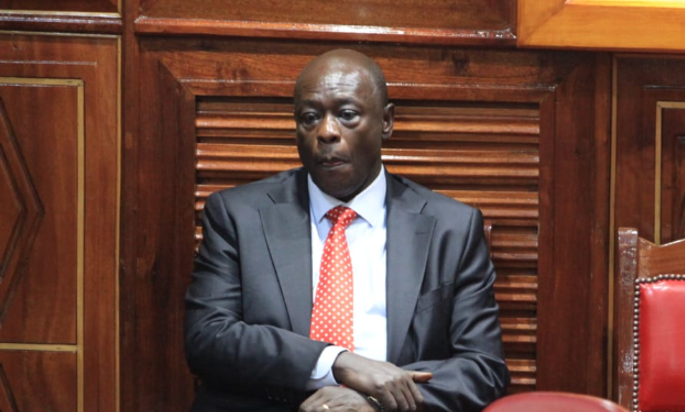
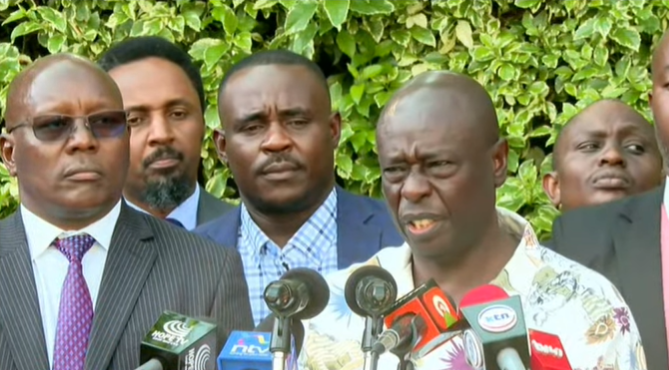
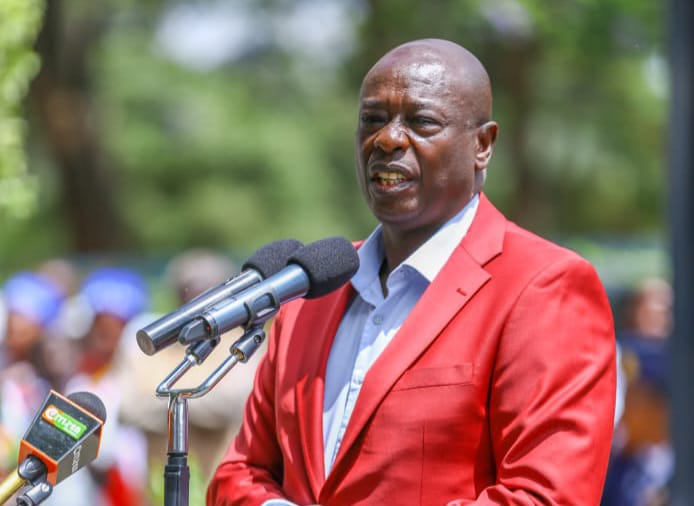
 Former Deputy President Rigathi Gachagua addressing the press flanked by his allies on June 9, 2026. /SCREENGRAB
Former Deputy President Rigathi Gachagua has described his October 2024 impeachment as a "constitutional coup", escalating his criticism of the Senate and the Judiciary a day after the High Court upheld his removal from office despite finding that his right to a fair hearing had been violated.
Addressing the press on Tuesday, Gachagua cited the court's finding that the Senate infringed his constitutional rights when it declined to adjourn impeachment proceedings after he fell ill and was admitted to hospital.
He argued that once the court established that his right to a fair hearing had been violated, the entire impeachment process should have been declared null and void.
"We strongly observe that the impeachment process was found faulty by the three-judge bench for failure to respect my right to a fair hearing in violation of Article 25, 47 and 50 of the Constitution. Once that determination was made, the entire process collapsed and was null and void. There was no impeachment; this was a constitutional coup, an abuse of the people of independent Kenya," Gachagua said.
The former deputy president accused the Senate of disregarding the principles of natural justice by denying him an opportunity to adequately defend himself before reaching a decision that led to his removal from office.
He cited Article 25 of the Constitution, which protects certain rights from limitation under any circumstances, including the right to a fair trial.
"Article 25 of our constitution provides rights that are non-derogable - they cannot be limited under any circumstances - and the core is provision to fair trial," he said.
Gachagua also pointed to Article 47 on fair administrative action and Article 50 on the right to a fair hearing, arguing that the judges had affirmed that those constitutional guarantees were breached during the impeachment proceedings.
His remarks came a day after a three-judge bench comprising Justices Eric Ogola, Anthony Murima and Freda Mugambi delivered judgment in a consolidated petition challenging his impeachment.
The judges agreed with Gachagua that his fair trial rights had been infringed when the Senate rejected requests to postpone proceedings after he was hospitalised.
"We have found that the fair trial rights of His Excellency Gachagua were infringed when the Senate declined to allow the adjournment," the court held.
However, the bench declined to overturn the impeachment, holding that the court's powers in such circumstances were limited by the Constitution and subsequent events following Gachagua's removal.
In its judgment, the court held that the Constitution remained the supreme law and that courts must respect limits expressly placed on their authority.
"The constitution is the grundnorm, and where that grundnorm deliberately and clearly limits the power of the court, that limitation must be respected," the judges stated.
The court further held that setting aside the impeachment would create constitutional complications because a new Deputy President had already been lawfully nominated, vetted and sworn into office.
According to the judges, overturning the Senate's decision at this stage risked creating uncertainty over occupancy of the country's second-highest office and could result in competing claims to the position.
The court therefore upheld the impeachment and awarded Gachagua Sh50 million in damages for the violation of his constitutional rights.
Gachagua, however, rejected the award, describing it as an insult to the Constitution and a mockery of the rights whose violation the court had acknowledged.
"We are not interested; money was never the issue here, justice and constitutional supremacy were. If I were interested in money, Ruto had offered me Sh2 billion in an effort to entice me to avoid impeachment and choose resignation, but I stood for my rights and those of over seven million Kenyans who voted for me," Gachagua claimed.
"No offer, no amount of money can stand between me, my rights, and the rights of the citizens of Kenya under the constitution. If I could reject Sh2 billion, offering me Sh50 million is a serious joke."
The ruling has sparked debate among constitutional lawyers, some of whom have questioned how the court could find that a non-derogable right was violated while upholding the outcome of the process in which the violation occurred.
Several legal experts have argued that the finding on fair hearing raises constitutional questions that are likely to be tested before the Court of Appeal.
Gachagua has publicly declared his intention to challenge President William Ruto in the 2027 General Election.
On Tuesday, he confirmed that he would move to the Court of Appeal in a bid to overturn the judgment and secure a declaration that his impeachment was unconstitutional.
Several lawyers have argued that Gachagua has a strong case on appeal. Law Society of Kenya President Charles Kanjama said he remains free to vie for public office as he awaits the outcome of the appellate process.
The next phase of litigation is expected to test broader constitutional questions relating to due process, parliamentary accountability and the limits of judicial intervention in constitutional disputes.






![[PHOTOS] Ruto pushes for stronger Kenya-EU economic ties in Brussels](https://cdn.radioafrica.digital/image/2026/06/3aebc395-285b-441c-8aa4-33cb538f8d44.jpg)