

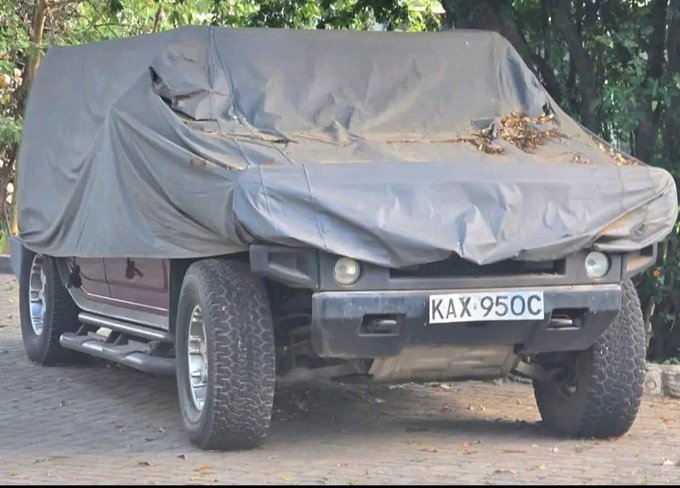
Raila Junior, the son of the late former Prime Minister Raila
Odinga has said that he plans to restore his father’s signature Hammer Car.
According to Junior, after the restoration, the vehicle will
be taken to Kang’o Ka Jaramogi's family mausoleum, where his father was buried.
“My intention is to restore and take it to the museum at
Kango Ka Jaramogi,” he said.
He was responding to a post on X that said the car had been
sent parking and the former PM had rested.
The Hummer — once a campaign vehicle — is being transformed
into a historical symbol, intended to preserve a tangible piece of Kenya’s
political memory with the Odinga family.
The “Hammer” refers to a flashy Hummer H3 that Raila
acquired ahead of the 2007 general election.
The vehicle was gifted to him by benefactors supporting his
presidential bid, particularly one Don Bosco Gichana.
At campaign rallies, the red Hummer became a spectacle.
Supporters would chant “Hummer! Hummer! Hummer!” as Odinga rode in it,
projecting an image of power and strength that resonated widely.
The car quickly transcended its function — it became a
political brand. From “Hummer” came “Hammer” (Nyundo), which symbolised
Odinga’s force and appeal in Kenyan politics.
After the 2007 election and ensuing crisis, the car
gradually faded from public view — making only a brief appearance in 2008.
Upon seeing Raila Junior’s plans for the car, Raila’s former
long-term aide, Silas Jakakimba hailed the decision, further revealing that he
was among the first people to see the car before it became a central symbol of
Raila Odinga’s presidential campaign.
“One of the unknown stories about this hammer machine is
that I was the first to lay my eyes on it,” he wrote. Jakakimba recounted
meeting Bosco, the eventual donor of the vehicle, and immediately recognising
its potential impact on Raila Odinga’s campaign appearances.
“I told him, ‘Ndugu, I have a feeling this car has the
uniqueness we'd covet for Jakom's campaign appearances.’ He responded, ‘Do you
think Mzee would like it too?’ I replied, ‘If I tell you we’d covet its impact
in the terrains, rest assured PM would be aligned’,” Jakakimba narrated.
The Hummer became one of the most recognisable features of
Odinga’s 2007 presidential bid, often drawing crowds and symbolising strength
and resilience. According to Jakakimba, Bosco later donated the vehicle to the
campaign, which he notes “won the presidential vote by majority.”
Jakakimba applauded Raila Odinga Jr.’s decision to preserve
the vehicle, calling it “a timely and befitting” move. He said placing the car
at the Jaramogi Museum would safeguard a significant chapter of Raila Odinga’s
political journey and his efforts “to transform and turn around the governance
architecture of the Republic of Kenya.”
The Hammer’s relocation marks a renewed effort to document
and preserve artefacts linked to the Odinga family’s long-standing influence in
Kenya’s political landscape.