

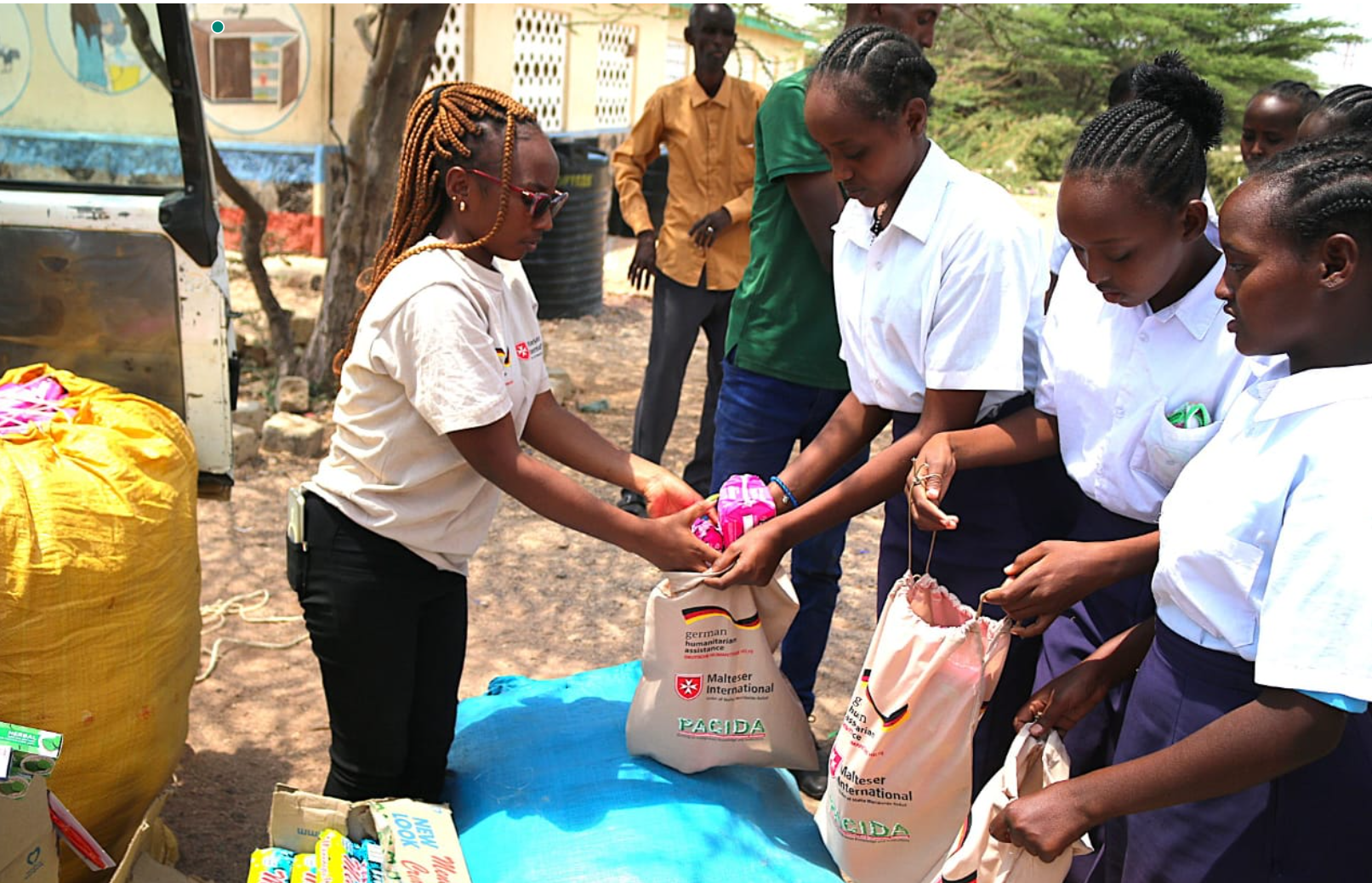
 Dignity Kits distribution at Kalacha Nomadic Girls School in Marsabit.
In Marsabit County, one of Kenya’s arid and semi-arid regions, access to sanitary pads remains a major barrier to girls’ education. Many families prioritise food and other essentials over menstrual products, leaving schoolgirls to face their periods unprepared.
When Sobale Umuro, a grade 9 pupil at Kalacha Nomadic Girls School, experienced her first period in class, she was confused and afraid. With no prior knowledge of menstruation or access to sanitary pads, she quietly shared her situation with a friend.
“I spoke to my best friend in school, and she explained to me what I was experiencing. We didn’t have any sanitary towels, so we went and borrowed from one of our teachers. Since then, I’ve known how to use them,” said Umuro.
Across Marsabit, countless girls share Umuro’s experience. The high cost of sanitary pads, limited availability, and lack of clean water make it difficult to manage menstruation safely and with dignity. Many girls report to school without pads, relying on what the school provides.
“When I left home, I didn’t carry any sanitary pads; we depend on the ones the school gives us,” Umuro added.
Christine
Kathure, a teacher at Kalacha Nomadic Girls, said some students come from
single-parent families, while others are orphans and unable to afford even the
most basic hygiene supplies. “We don’t have much as teachers, but we try to
share with them when a student lacks pads,” she said. “We’ve also created an
open environment where girls can talk freely with teachers, and how older
students can help the younger students.”
A few kilometres away, at Kalacha Girls High School, Head of Institution Hawo Hassan faces the same challenges. “During the mid-term break, three-quarters of the students don’t go home because of the distance. They go to their relatives. When they come back, they often lack basic necessities. Here, at least, they feel secure enough to ask for help,” said Hawo.
She added that when students lack sanitary products, it affects their confidence and performance. “As humans, if you don’t have what you need, you won’t be at ease. Some compare themselves with others, and this leads to low self-esteem and poor concentration,” she said.
To bridge this gap, PACIDA, a non-profit organisation with funding support from German Humanitarian Assistance through Malteser International, distributed dignity kits to five schools across Marsabit County, including Turbi Primary, Tiigo School, Kalacha Nomadic Girls, Kalacha Girls High School, and Turbi Nomadic Girls.
Each student received three packs of sanitary towels, two undergarments, a bar of soap, toothpaste, and a toothbrush.
“The donations we’ve received will ensure every girl has what she needs during the holidays,” said Hawo. “Without such support, some of them may not return to school in January. A few might even be married off because their parents cannot provide for them.”
Kathure believes this burden should not fall solely on well-wishers. “It’s the responsibility of the government to ensure that every school-going girl has access to sanitary pads,” she said.
For Sobale and other girls, access to sanitary pads is not just a health issue, but a matter of educational equity and empowerment. These kits not only help them stay in school but also boost their confidence and dignity.